

The 2025 Men’s Health Report: Microplastics, the "Muscle Gap," and the End of BMI
This guide breaks down The 2025 Men’s Health Report: Microplastics, the "Muscle Gap," and the End of BMI into the key mechanisms and the decisions that matter in practice. If the last decade of men’s health was about "Optimization" (supplements, TRT, biohacking), 2025 is shaping up as the year of Defense and Longevity: protecting endocrine function, preserving muscle, and measuring what actually predicts lifespan—not what looks good in a mirror.
Key takeaways
- 2025 is less about "hacking" and more about risk management: reducing endocrine disruptor exposure, stabilizing metabolic health, and keeping strength as you age.
- The new headline metric is muscle (and function), not weight: clinics are increasingly prioritizing FFMI, waist-to-height ratio, grip strength, and VO₂max proxies over BMI.
- Microplastics and other xenobiotics are moving from "environmental news" into male fertility and hormone conversations—especially around testicular health.
In 2025, the strongest man isn’t the biggest one; it’s the most resilient one.
Deep dive
New research and clinical practice trends are converging on a blunt message: men are trying to solve modern health problems with old tools. A supplement stack can’t outcompete chronic sleep debt. A weekly HIIT class can’t erase a desk job. And BMI can’t detect the most dangerous body composition pattern of this decade: low muscle + hidden visceral fat. Below is what’s changing in 2025—and what to do about it.
1) The "Plastic" Crisis: From Environmental Issue to Reproductive Issue
Microplastics have become the defining contaminant narrative because they are not only everywhere—they can also carry other chemicals (plasticizers, flame retardants) that interact with hormone signaling. In late 2024 and into 2025, several studies and reviews accelerated public attention by reporting microplastic particles in human reproductive tissues and raising concerns about fertility markers.
- What this means (without the panic): the male endocrine system is sensitive to chronic, low-dose exposure. The question is less "are microplastics present?" and more "how much, what type, and what do they do over 20 years?"
- Why testicular tissue is a focal point: testes are metabolically active, hormone-driven, and highly vascularized—making them plausible targets for bioaccumulation and inflammation pathways.
- The practical shift: longevity clinics increasingly treat "toxic load" as a modifiable risk factor, similar to blood pressure or ApoB.
It is important to be precise: the science is still evolving, causality is difficult to prove, and results vary by study design. But the preventive strategy is straightforward because it overlaps with other health wins: reduce avoidable exposure, especially where heat + plastic + food meet.
The 80/20 Anti-Exposure Protocol
You do not need to live in a glass dome to reduce exposure. In practice, most gains come from a few repeatable rules that cut the biggest sources.
- 1. Stop heating food in plastic. Heat accelerates leaching. Switch to glass/ceramic for microwaving and hot leftovers.
- 2. Treat takeout as a risk multiplier. Hot, oily foods in plastic-lined containers concentrate transfer. If you eat takeout often, re-plate immediately and avoid reheating in the original packaging.
- 3. Filter drinking water (and consider your kettle). A quality filter can reduce multiple contaminants; if you boil water frequently, prefer stainless steel or glass rather than plastic reservoirs.
- 4. Attack household dust. Many endocrine disruptors ride on dust. Vacuum with HEPA, wet-wipe surfaces weekly, and ventilate bedrooms (where you spend a third of your life).
- 5. Upgrade the "high-contact" items. If you change only a few things, change the ones you touch daily: food storage, water bottle, coffee cup lids, and cutting boards.
2) The Muscle Gap: The New Silent Epidemic
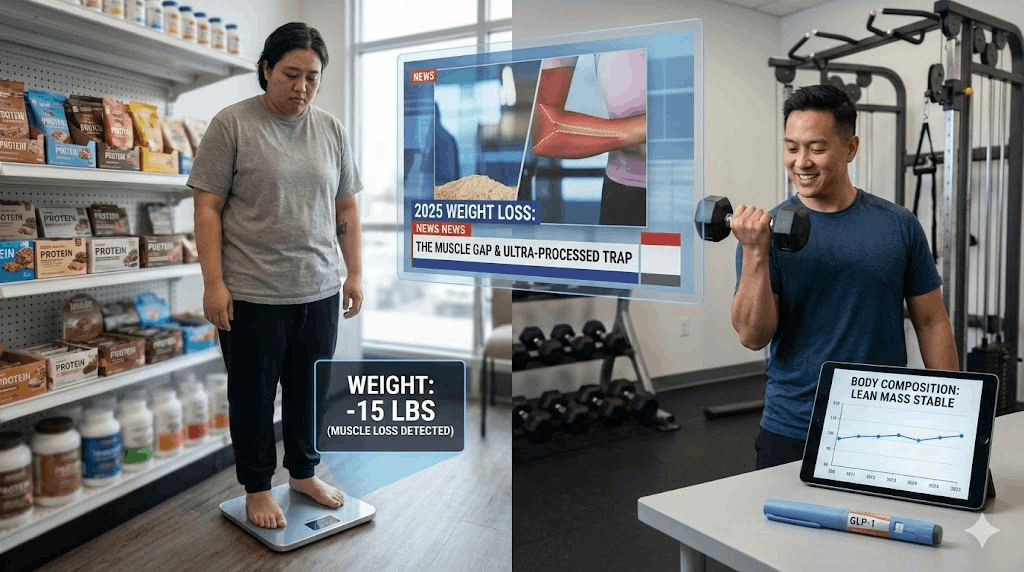
In 2025, clinicians are describing a widening muscle gap: men are heavier (or at least not lighter), yet functionally weaker. A large portion of the population is carrying more fat mass and less lean mass than their weight suggests—especially in midlife. This is the setup for insulin resistance, lower testosterone, and a faster slide into frailty.
- Sarcopenic obesity: a body composition pattern where muscle is low and fat—often visceral—is high, even if BMI looks "acceptable."
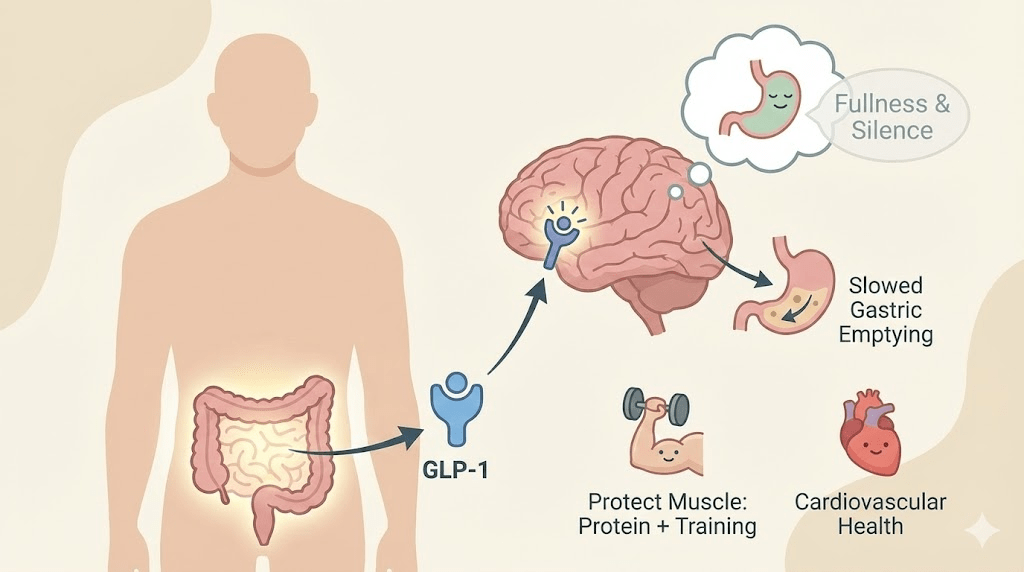
- The GLP‑1 complication: rapid weight loss can include substantial lean mass loss unless protein and resistance training are intentionally programmed.
- Why it matters: skeletal muscle is not cosmetic tissue. It is a glucose disposal organ, an amino acid reservoir, and a key driver of metabolic resilience.
The behavioral trap is obvious: many men respond to fatigue by doing more cardio and eating less. That often worsens the muscle gap by amplifying stress hormones and under-fueling training. In 2025, the model is shifting to Muscle-Centric Medicine: keep or build lean mass first, then cut fat in a way that preserves performance.

The Muscle-Sparing Playbook
If your primary goal is longevity (not just aesthetics), the baseline strategy is remarkably consistent across clinics:
- Protein as a floor, not a bonus: aim for a daily target that is realistic and repeatable (many protocols fall in the 1.6–2.2 g/kg/day range, adjusted for age, training, and appetite).
- Lift heavy, not endlessly: 2–4 sessions per week of compound lifts beats seven days of random circuits for long-term muscle retention.
- Zone 2 as the support act: low-intensity cardio supports mitochondrial function and heart health, but it should not cannibalize recovery from strength work.
- Creatine and vitamin D as the boring winners: not magic, but among the most consistently useful for strength, performance, and (in D’s case) broader health markers when deficient.
3) The End of BMI: What Replaces It
BMI is not "wrong"—it is just incomplete. It cannot separate muscle from fat, and it cannot locate fat (subcutaneous vs. visceral). In 2025, many men are learning the hard way that you can look normal in clothes while carrying a dangerous amount of visceral fat—or you can be labeled "overweight" while being muscular and metabolically healthy.
The replacement is not one number. It is a small dashboard of metrics that triangulate risk more accurately.
The 2025 metric dashboard
- Waist-to-height ratio: a simple proxy for visceral fat risk (waist circumference relative to height).
- FFMI (Fat-Free Mass Index): a muscle-centric index that helps distinguish lean tissue from total weight.
- Resting blood pressure + ApoB (or non-HDL): the vascular reality check.
- HbA1c and fasting insulin (or HOMA-IR): the insulin resistance early warning system.
- Grip strength / carry capacity: the function metric that predicts outcomes better than most people expect.
Grip Strength Is Becoming the New Blood Pressure
In 2025, more clinics are using simple, low-tech performance tests because they summarize whole-body health: nervous system recruitment, muscle quality, and recovery capacity. Grip strength is popular because it’s cheap, fast, and surprisingly predictive of long-term outcomes.
- If your grip is dropping year over year, something is changing—often sleep, nutrition, stress, or training quality.
- "Hang time" and carries are practical proxies: if you cannot hang from a bar or carry moderate loads without collapsing, you may be losing functional reserve.
4) Mental Health in 2025: The Shift Toward Somatic Tools
The mental health conversation for men is moving away from purely cognitive models and toward somatic regulation—treating stress as physiology, not just psychology. This is partly cultural and partly practical: many men engage better with tools they can do than emotions they must explain.
- Breathwork and downshifts: short protocols (e.g., longer exhales) to reduce autonomic arousal in real time.
- Cold and heat exposure (used intelligently): not as macho tests, but as nervous-system training—dose matters.
- Mobility and strength as therapy: consistent training often improves mood by improving sleep, confidence, and blood sugar stability.
A key nuance: somatic tools are not a replacement for therapy when trauma, depression, or addiction are present. They are the foundation that makes higher-level work possible.
5) The Unsexy Triangle: Sleep, Alcohol, and Ultra-Processed Food
The fastest way to sabotage endocrine health is to treat recovery as optional. In 2025, clinics are increasingly blunt: if sleep is poor, alcohol is frequent, and diet is dominated by ultra-processed food, no supplement stack will save testosterone or metabolic health.
- Sleep debt raises cortisol and worsens insulin sensitivity, which pushes fat storage—especially visceral—exactly where men don’t want it.
- Alcohol is a multiplier: it disrupts sleep architecture, worsens inflammation, and often drives late-night snacking behaviors that keep insulin elevated.
- Ultra-processed foods are engineered for overeating: they increase caloric intake while reducing nutrient density, driving the exact nutrient gaps men try to patch with pills.
Practical next steps
- Replace BMI thinking with a dashboard: measure waist, track strength, and get cardiometabolic labs (blood pressure, lipids, glucose/insulin markers).
- Run the 80/20 anti-exposure protocol for 30 days: no heating plastic, filter water, reduce dust load, upgrade high-contact items.
- Adopt a muscle-sparing baseline: 2–4 strength sessions/week, protein target met most days, and Zone 2 as support (not punishment).
- Pick one nervous-system downshift tool and practice it daily for two weeks (consistency beats novelty).
Common pitfalls
- Chasing "detox" extremes while ignoring the basics (sleep, diet quality, strength training).
- Using GLP‑1s or aggressive dieting without a muscle-preservation plan (protein + resistance training).
- Replacing training with supplements instead of using supplements to support training.
- Relying on BMI or scale weight to judge health while visceral fat and muscle loss go unnoticed.
Quick checklist
- Waist measurement is tracked monthly (not daily weight).
- Protein target is met most days.
- Strength work is scheduled and progressive.
- Sleep window is protected 5+ nights/week.
- Plastic + heat contact is minimized (food, water, and hot drinks).