The Friday Night Fracture: Anatomy of the Weekend Rebound
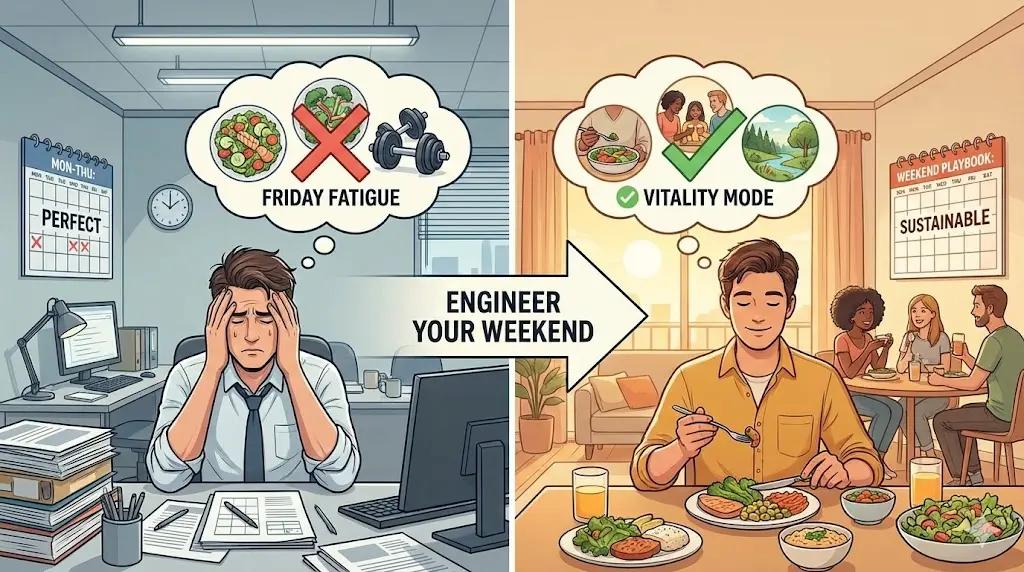
It is a scene repeated in millions of households every week. You have been 'perfect' since Monday morning. You’ve hit your protein targets, attended every gym session, managed your stress, and navigated the mid-week slump with grace. But then, Friday afternoon arrives. As the clock strikes 5:00 PM, a subtle shift occurs in your internal narrative. The structure that felt supportive on Tuesday suddenly feels like a cage. By 8:00 PM, the 'Perfect Week' has fractured, replaced by a weekend-long rebound of indulgence, sedentary behavior, and social pressure that often negates the hard-won progress of the previous four days. In the behavioral landscape of 2026, we call this the 'Weekend Rebound,' and it is not a sign of weakness—it is a predictable result of how our brains handle decision fatigue, environmental cues, and psychological permission.
The weekend rebound is particularly frustrating because it feels like a loss of control. We often blame a lack of willpower, but willpower is a biological resource that is frequently exhausted by the time the weekend begins. When we understand the mechanics of habit design and environmental engineering, we realize that the weekend shouldn't be a period we 'survive' through grit; it should be a period we enjoy through better architecture. To fix the weekend, we must stop looking at it as a moral test and start looking at it as a design problem. This article is your behavioral playbook for bridging the gap between your weekday discipline and your weekend freedom.
The Decision Fatigue Trap: Why Willpower Ends at 5 PM
The primary reason your Friday night feels like a free-fall is a phenomenon known as decision fatigue. Throughout the workweek, you make thousands of micro-decisions: what to wear, which email to prioritize, how to handle a difficult colleague, and—most importantly—what to eat. Every time you resist a craving or choose the 'healthy' option, you are using a portion of your cognitive load. By Friday evening, your prefrontal cortex—the part of the brain responsible for executive function and long-term goal planning—is effectively 'offline' due to sheer exhaustion.
In this depleted state, your brain defaults to the path of least resistance. You are no longer making choices based on your 2026 goals; you are making choices based on immediate dopamine rewards. This is why the idea of cooking a balanced meal feels impossible, but ordering a hyper-palatable takeout feels like a necessity. When your brain is tired, it stops being a 'strategist' and starts being a 'survivalist,' seeking out the densest energy sources available to replenish its perceived depletion. To fix this, we must remove the need for Friday night decisions entirely.
Moral Licensing: The 'Permission' Mindset
Beyond the biological fatigue of the brain, there is a powerful psychological trap called Moral Licensing. This occurs when we do something 'good' (like eating salads all week), which then gives us subconscious permission to do something 'bad' (like overeating all weekend). We view our health behaviors as a bank account; we think we’ve built up enough credit from Monday to Thursday to 'spend' it all on Friday and Saturday. The problem is that the metabolic math doesn't care about your moral bookkeeping. Your body doesn't know you 'deserved' the pizza; it only knows that a massive influx of energy and inflammatory ingredients has arrived.
This permission mindset is often exacerbated by the language we use. When we call foods 'cheats' or 'treats,' we reinforce the idea that healthy living is a punishment and indulgence is a reward. This creates a binary relationship with our habits that is unsustainable. In 2026, high-performance coaching focuses on shifting this narrative from 'I’ve been good, so I can be bad' to 'I am a person who values vitality, and my weekend choices reflect that identity.' When you stop needing permission to eat, you stop needing to rebel against your own rules.
The weekend is not a break from your life; it is a part of your life. If your habits require a 'break,' they are likely too restrictive to be sustainable.
Restriction Backlash: The Pendulum of Monday to Thursday
One of the most common drivers of the weekend rebound is the 'starve-then-stuff' cycle. If your Monday through Thursday is defined by extreme caloric restriction, the elimination of entire food groups, or an obsessive focus on 'perfection,' you are setting a physiological pendulum in motion. The more you pull that pendulum toward restriction in the early part of the week, the harder it will swing toward overconsumption when the weekend arrives.
Physiologically, under-eating during the week increases your levels of ghrelin (the hunger hormone) and decreases leptin (the satiety hormone). By Friday, your body is in a state of 'nutrient debt.' It isn't just that you want the fries; your body is biologically demanding a massive caloric influx to ensure survival. This is why the 'perfect' week is actually the enemy of the successful weekend. A week that is 10% less 'perfect' but provides adequate calories and satisfaction is 100% more likely to result in a stable, controlled weekend.
The Alcohol Catalyst and Social Triggers
We cannot discuss the weekend rebound without addressing the elephant in the room: alcohol. Even one or two drinks on a Friday night act as a potent catalyst for poor decision-making. Alcohol is a central nervous system depressant that specifically targets the prefrontal cortex, lowering your inhibitions and blunting your ability to care about your long-term goals. Once the 'Executive' is asleep, the 'Impulse' takes over.
Furthermore, our social environments are often engineered for consumption. We meet friends at bars, celebrate at restaurants, and gather around food-centric events. In these settings, we are susceptible to 'Social Mimicry'—eating and drinking at the pace and volume of those around us. If your peer group views the weekend as a time to 'let go,' you will find yourself doing the same just to maintain social cohesion. Behavioral change in 2026 isn't just about changing what you eat; it's about changing the 'scripts' of your social interactions.
Social Jetlag: How Sleep Debt Sabotages Monday
Many people view the weekend as a time to 'catch up' on sleep, but this creates a phenomenon called Social Jetlag. When you wake up at 7:00 AM all week and then sleep until 10:00 AM on Saturday and Sunday, you are effectively shifting your internal clock three hours later, as if you had flown across the country. This circadian disruption causes metabolic havoc.
By Sunday night, you aren't tired at your normal bedtime because your rhythm is shifted. You stay up late, wake up exhausted on Monday morning, and start the week in a state of high cortisol and high hunger. This 'Monday Morning Fog' leads to poor food choices to compensate for the fatigue, which triggers the need to be 'extra perfect' from Tuesday to Thursday to make up for it, restarting the entire rebound cycle. Consistency in wake times is the most underrated metabolic tool in your arsenal.
What Most People Get Wrong about Weekend Progress
- Thinking the Weekend is 'Extra' Time: Viewing Friday to Sunday as separate from your health goals leads to a 30% reduction in your yearly progress.
- Using the 'All or Nothing' Filter: Believing that one 'off-plan' meal means the entire weekend is a wash and you should just keep eating until Monday.
- Underestimating Liquid Calories: Forgetting that cocktails, craft beers, and fancy lattes can easily add 1,500 calories to a weekend without adding any satiety.
- Rewarding Movement with Food: Thinking that because you went for a 5-mile hike on Saturday, you can eat a 2,000-calorie brunch. (You rarely burn as much as you think).
- Ignoring the Sunday Scaries: Using food as a primary coping mechanism for the anxiety of the upcoming workweek.
- Lacking a Friday 'Exit Strategy': Not having a pre-planned, easy meal for the transition from work-mode to home-mode.
- Failing to Track: Stopping your tracking or mindfulness practices on the weekend, which removes the 'awareness buffer' that prevents overeating.
The Weekend Plan: Engineering Your Environment
To fix the weekend rebound, we use a strategy called Environment Engineering. We don't rely on willpower; we rely on systems. Here is the 2026 Behavioral Playbook for a balanced, successful weekend.
1. The Friday Night Pre-Commitment
Before you leave work on Friday—while your 'Executive' is still somewhat awake—make one firm pre-commitment. This could be ordering your Friday night grocery delivery in advance, booking a Saturday morning workout class that has a cancellation fee, or deciding exactly what your 'Default Order' will be if you go out. By making the decision early, you avoid the decision fatigue trap later.
2. The Anchor Meal Strategy
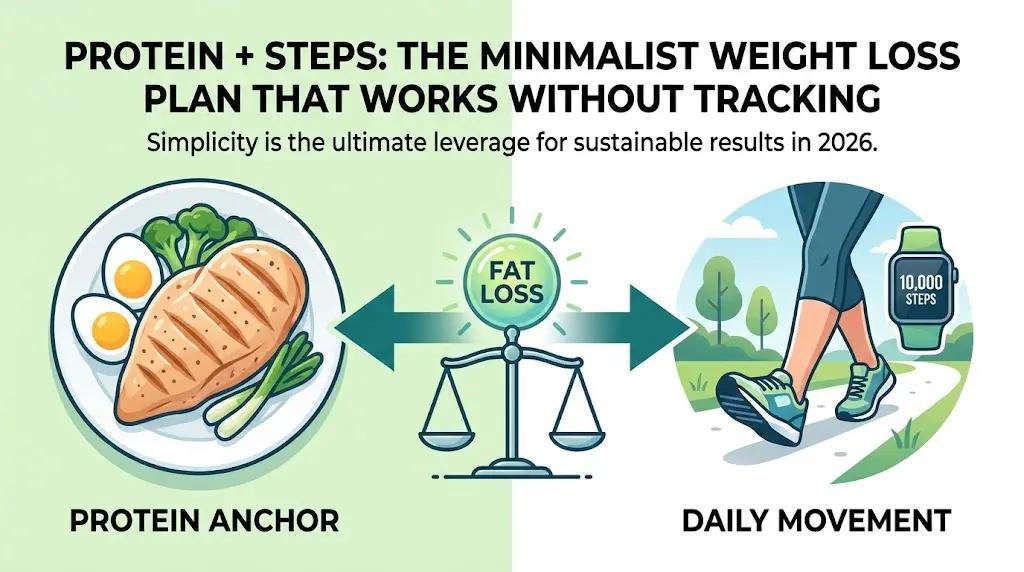
In 2026, we advocate for 'Anchoring.' This means you pick one meal a day that remains constant and high-protein, regardless of the weekend festivities. For most, this is breakfast. By having a high-protein, high-fiber 'Anchor Meal' on Saturday and Sunday morning, you stabilize your blood sugar and reduce the 'Hunger Signal' for the rest of the day, making it much easier to be moderate at dinner.
3. The Rule of Two
This is a simple behavioral constraint for social events. Pick two 'extras' and stick to them. For example: two drinks, or one drink and one appetizer, or two slices of pizza and a salad. This allows you to participate in the social joy without the 'All or Nothing' spiral. It provides a boundary that feels like a choice rather than a restriction.
4. The Sunday Recovery Routine
Instead of using Sunday to 'dread' Monday, use it as a day of low-stress preparation. This includes a 20-minute 'Friction Audit': looking at your upcoming week and identifying where you might struggle. Prepare one large 'Emergency Meal' on Sunday afternoon that you can freeze or refrigerate for those moments when life gets chaotic. This reduces the cognitive load for the upcoming week and prevents the Friday fatigue from building up.
A 7-Day Behavioral Experiment
To break the rebound cycle, try this low-pressure experiment for one week. The goal is not perfection; it is awareness and alignment.
- Monday-Thursday: Increase Your Intake. Add 150-200 calories of protein or fiber to your daily total. Notice if this reduces your 'desperation' for a treat by Friday evening.
- Friday 4:00 PM: The Transition Ritual. Spend 5 minutes doing deep breathing or a quick walk before leaving work. Tell your brain that work-mode is over and you are entering 'Vitality Mode.'
- Saturday: The Anchor Breakfast. Eat 30g of protein before 10:00 AM. See if it changes how much you eat at lunch.
- Sunday: The Circadian Reset. Wake up within 60 minutes of your weekday wake time. Notice if you feel more rested on Monday morning.
- The Reflection: On Monday morning, instead of feeling guilty, ask: 'What environmental trigger led to my biggest struggle this weekend, and how can I engineer it differently next time?'
Sources
- Baumeister, R. F., & Tierney, J. (2026). Willpower: Rediscovering the Greatest Human Strength in a Digital Era.
- Duhigg, C. (2025). The Power of Habit: Why We Do What We Do in Life and Business.
- Clear, J. (2026). Atomic Habits: An Easy & Proven Way to Build Good Habits & Break Bad Ones.
- Walker, M. (2025). Why We Sleep: Unlocking the Power of Sleep and Dreams.
Disclaimer: This article is for educational purposes only and does not constitute medical or psychological advice. Consult with a qualified professional before making significant changes to your diet, exercise, or lifestyle routines, especially if you have underlying health conditions or eating disorders.