Strength Training as a Metabolic Intervention: Why Muscle Improves Insulin Sensitivity
In the health landscape of 2026, we have moved beyond the simplistic view of exercise as merely a way to 'burn calories' or 'look better.' We are witnessing a profound paradigm shift where movement is viewed as a form of precision medicine. At the heart of this revolution is the understanding of skeletal muscle—not just as a system for locomotion, but as the body's largest and most influential metabolic organ. While cardiovascular health remains vital, strength training has emerged as the premier metabolic intervention for addressing the root cause of modern metabolic dysfunction: insulin resistance.
Insulin resistance is often described as the 'silent pandemic' of the 21st century, acting as the underlying driver for weight gain, PCOS, Type 2 diabetes, and cardiovascular disease. For decades, the primary advice was to 'eat less and do more cardio.' However, this approach often neglects the very tissue responsible for over 80% of post-meal glucose disposal. By focusing on building and maintaining muscle through resistance training, we aren't just changing our physique; we are upgrading our biological hardware and creating a 'metabolic sink' that can handle the modern influx of dietary energy.
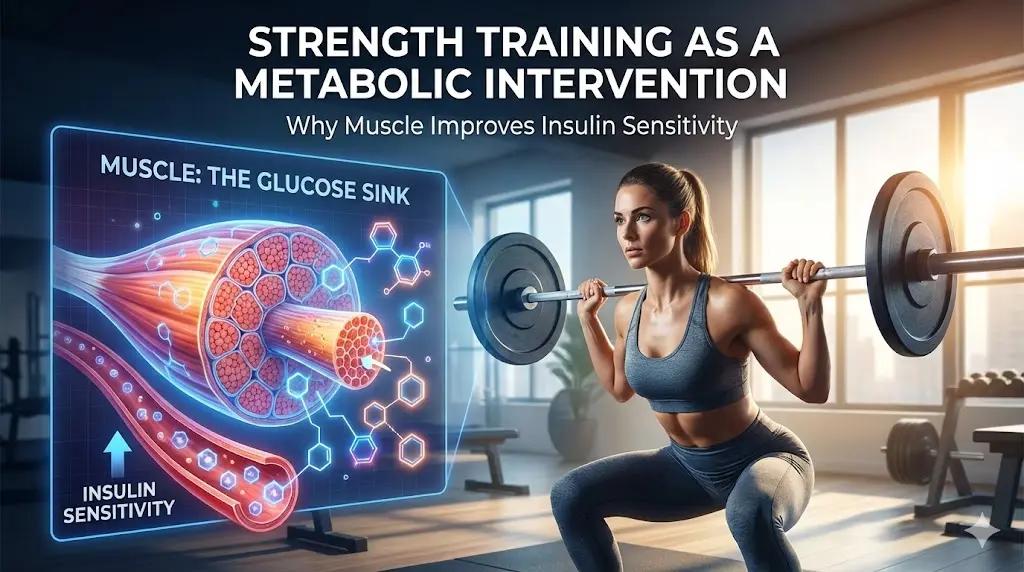
The Glucose Sink: How Muscle Disposes of Sugar
To understand why muscle is so critical for metabolic health, we have to look at how the body handles glucose. Every time you consume carbohydrates, they enter the bloodstream as sugar. To keep blood sugar levels in a safe, narrow range, the pancreas secretes insulin, which signals cells to take up that sugar. Skeletal muscle is the primary destination for this glucose. In a metabolically healthy individual, muscle tissue acts like a vast, thirsty sponge, soaking up glucose to store it as glycogen for future movement.
When we lack sufficient muscle mass, or when our existing muscle becomes 'marbled' with fat (intramyocellular lipids), that sponge becomes saturated and less effective. The insulin 'key' no longer turns the 'lock' on the muscle cell as easily. This is the beginning of insulin resistance. By engaging in regular strength training, we do two things: we increase the size of the sponge (more muscle mass), and we increase the 'thirst' of the sponge (glucose transport efficiency). Even a single bout of resistance training increases glucose uptake for up to 24-48 hours, making it a powerful, short-term pharmaceutical-grade intervention with long-term structural benefits.
The GLUT4 Mechanism: Exercise-Induced Glucose Uptake
One of the most fascinating aspects of strength training in 2026 is our understanding of the GLUT4 translocation process. Usually, glucose needs insulin to enter a cell. However, intense muscle contraction triggers a 'backdoor' entry. When you lift weights, the mechanical stress and calcium release in the muscle signal GLUT4 (glucose transporter type 4) proteins to move to the cell surface and pull in sugar—even if insulin levels are low or the cells are insulin-resistant. This is known as insulin-independent glucose uptake.
This means that for someone struggling with metabolic dysfunction, strength training is the most effective way to lower blood sugar without forcing the pancreas to pump out more insulin. Since chronically high insulin is the hormone that signals the body to store fat and prevents fat-burning, using muscle contraction to clear glucose is a metabolic 'cheat code.' It allows you to maintain stable energy levels and lower systemic inflammation while giving your pancreas a much-needed break.
Muscle as an Endocrine Organ: The Power of Myokines
In the New Age of endocrinology, we no longer see muscle as 'dumb' tissue that only moves bones. We now know that muscle is a secretory organ. When muscles contract against resistance, they release hundreds of small signaling molecules called myokines. These myokines travel through the bloodstream and communicate with the liver, the brain, and even your adipose (fat) tissue.
One well-known myokine, Irisin, has been shown to 'brown' white fat, turning stubborn storage fat into metabolically active tissue that burns energy for heat. Other myokines, like Interleukin-6 (IL-6), when released acutely from muscle during exercise, actually have anti-inflammatory effects and help improve insulin sensitivity in the liver. By building muscle, you are effectively installing a 'pharmacy' inside your body that regularly dispenses health-promoting chemicals every time you train.
Mitochondrial Health: The Cellular Powerhouse Upgrade
Insulin resistance is often a symptom of mitochondrial dysfunction. When our cellular powerhouses become sluggish or damaged, they can't burn fuel efficiently, leading to a 'backup' of energy that manifests as high blood sugar and fat storage. Strength training is a potent stimulus for mitochondrial biogenesis—the creation of new, healthy mitochondria.
By challenging our muscles, we force the cells to adapt by becoming more efficient at energy production. Resistance training, specifically when it involves 'time under tension' or reaching 'local muscular failure,' creates a metabolic demand that 'prunes' away weak mitochondria and replaces them with robust ones. In 2026, we view muscle not just as a tool for strength, but as a sanctuary for the mitochondria that determine our biological age.
Muscle is the currency of longevity. It is the only tissue that pays you back with interest in the form of metabolic stability and hormonal health.
The Hormone Connection: Testosterone, Growth Hormone, and Cortisol
For women especially, the hormonal benefits of strength training are revolutionary. Many women fear that lifting weights will make them 'bulky,' but in 2026, we understand that muscle is the primary protector of the female endocrine system. Strength training boosts natural growth hormone and supports healthy testosterone levels (yes, women need it too!), both of which are essential for maintaining a fast metabolism and a sharp mind.
Furthermore, muscle provides a buffer against the 'Stress Signal.' Chronic stress leads to high cortisol, which breaks down muscle and deposits fat around the midsection (visceral fat). However, a body with more muscle mass is more resilient to cortisol. Strength training essentially 'widens the container' for stress, allowing you to handle life's pressures without a total metabolic collapse. When you train for strength, you are training your nervous system to stay calm under load—a skill that translates directly to metabolic resilience.
Practical 2026 Intervention Strategies
So, how do we use strength training as a clinical-grade metabolic intervention? It doesn't require living in the gym. In 2026, the 'Minimum Effective Dose' for metabolic health has been identified through large-scale data analysis. To significantly improve insulin sensitivity, the focus should be on intensity and consistency rather than duration.
- Compound Movements First: Focus on exercises that use multiple joints and large muscle groups, such as squats, deadlifts, presses, and rows. These provide the largest 'metabolic bang for your buck.'
- Two to Three Full-Body Sessions: Research shows that 2-3 sessions per week, hitting all major muscle groups, is enough to significantly alter insulin sensitivity and glucose disposal rates.
- Progressive Overload: You must give your muscles a reason to grow. This means gradually increasing the weight, the repetitions, or the 'difficulty' of the movement over time. A static routine leads to a static metabolism.
- Focus on the Eccentric: The 'lowering' phase of a lift causes the most structural change and metabolic demand. Slowing down the eccentric portion of your movements can double the metabolic impact of your workout.
- Post-Workout Nutrition: To support the metabolic 'sink,' prioritize high-quality protein after training. This provides the amino acids necessary to repair and build the very tissue that manages your blood sugar.
The Myth of 'Toning' and the Reality of Muscle Quality
In 2026, we have retired the word 'toning.' What people describe as 'toning' is simply the act of building muscle and losing the fat that covers it. From a metabolic perspective, we care about Muscle Quality. You can have two people with the same arm circumference, but one has 'dense' muscle filled with mitochondria, while the other has 'soft' muscle infiltrated with fat. Strength training is the only way to improve the 'density' and quality of that tissue, ensuring it remains an active participant in your metabolic health rather than a passive bystander.
Conclusion: Building a Metabolic Fortress
Strength training is no longer an optional hobby for athletes; it is a fundamental requirement for anyone living in the modern, sugar-rich environment of 2026. Every pound of muscle you gain is an insurance policy against chronic disease. It is a biological shield that protects your heart, your brain, and your hormonal health.
If you are struggling with stubborn weight, brain fog, or erratic energy, stop looking at the treadmill and start looking at the dumbbells. By choosing to get stronger, you are choosing to become more metabolically flexible. You are choosing to turn your body from a storage vessel into an energy-burning machine. Muscle is the foundation of the 'New Age' of health—it's time to build yours.