

For the better part of the last century, we have been conditioned to view our health through a single, narrow lens: the bathroom scale. We wake up, step onto a cold piece of glass and metal, and allow a flickering digital number to dictate our mood, our self-worth, and our dietary choices for the rest of the day. In the high-performance culture of 2026, we are finally recognizing that this obsession with total body weight is not only psychologically damaging—it is scientifically flawed. True metabolic health is a complex, beautiful symphony of cellular energy production, hormonal balance, and nutrient partitioning that a simple gravitational measurement can never fully capture.
The problem with the scale is that it treats all mass as equal. It cannot distinguish between the dense, metabolically active muscle that powers your movement and the visceral fat that may be putting stress on your internal organs. It cannot tell you if your cells are effectively processing glucose or if your mitochondria are struggling to produce ATP. As we enter a new era of personalized wellness, it is time to shift our focus from 'weight loss' to 'metabolic optimization.' By understanding the metrics that actually matter, we can achieve a state of vibrant health without the toxic cycle of obsession.
The Great Deception: Why the Scale is a Poor Health Metric
To understand why the scale misleads, we must first look at the concept of body composition. A person can be 'thin' according to their Body Mass Index (BMI) but possess dangerously high levels of internal fat—a condition often referred to as 'TOFI' (Thin Outside, Fat Inside). Conversely, an athlete with significant muscle mass might be classified as 'overweight' despite having perfect blood pressure, high insulin sensitivity, and incredible cardiovascular endurance. Muscle is roughly 15% denser than fat, meaning it takes up much less space while weighing the same. If you are improving your metabolic health through strength training and high-protein nutrition, you might lose two inches off your waist while the scale doesn't move an inch. This is progress, yet many people quit their routines because the scale 'lied' to them about their success.
Furthermore, the scale is highly sensitive to water retention, glycogen storage, and inflammation. A salty meal, a hard workout, or even a poor night's sleep can cause the body to hold onto several pounds of water. When we obsess over these daily fluctuations, we are essentially tracking 'noise' rather than 'signal.' To find the signal, we must look deeper into our biology.
Pillar 1: Blood Sugar Stability and Glycemic Variability
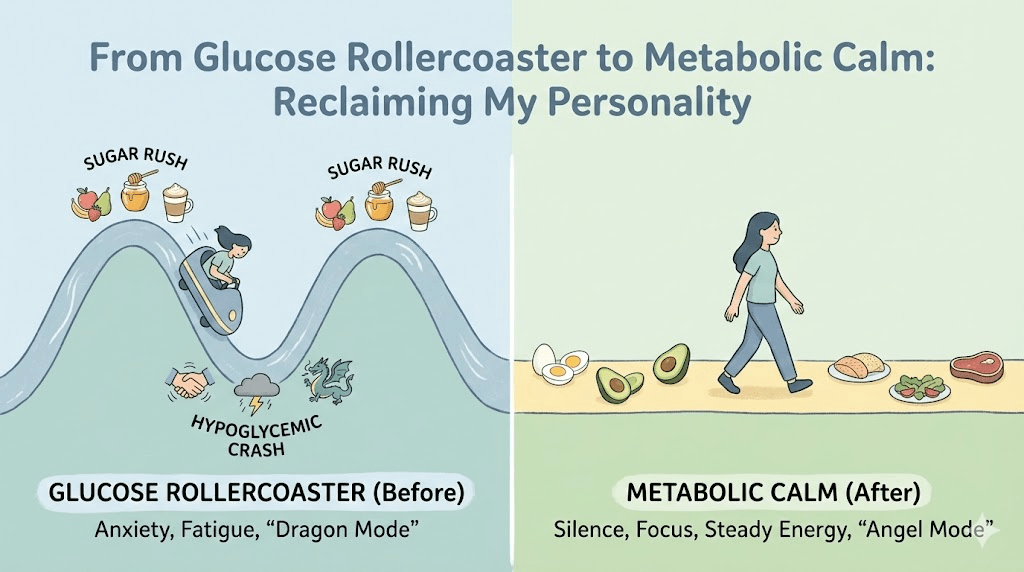
In 2026, the most significant indicator of metabolic health is how your body handles glucose. Ideally, your blood sugar should stay within a relatively narrow range, rising gently after a meal and returning to baseline without a sharp 'crash.' When we see high glycemic variability—meaning sharp spikes followed by deep plunges—we see a body under metabolic stress. These spikes damage the delicate lining of our blood vessels (the endothelium) and lead to the overproduction of insulin.
- The Post-Lunch Crash: Feeling an irresistible urge to nap between 2 PM and 4 PM.
- Hanger: Experiencing intense irritability or shakiness if a meal is delayed.
- Night Sweats or Waking at 3 AM: This is often caused by a blood sugar drop during the night, triggering a cortisol spike to pull you back into balance.
- Skin Tags or Darkened Skin Patches: Physical manifestations of chronic hyperinsulinemia (high insulin).
Instead of stepping on the scale, pay attention to your energy stability. A metabolically healthy person can go several hours without food while maintaining steady focus and a calm mood. This 'metabolic flexibility' is a much more valuable asset than a lower number on the scale.
Pillar 2: Waist-to-Height Ratio (The 'Space' Metric)
If you must use a tool for physical measurement, put away the scale and pick up a simple measuring tape. The Waist-to-Height ratio is a far more accurate predictor of long-term health than BMI. Specifically, we are looking at the accumulation of visceral fat—the fat that wraps around your liver, kidneys, and heart. This type of fat is 'metabolically active' in the worst way; it secretes inflammatory cytokines that disrupt your hormones and increase your risk of chronic disease.
A simple rule for 2026 is to keep your waist circumference at less than half of your height. For example, if you are 70 inches tall 5'10, your waist should ideally be 35 inches or less. This metric accounts for your unique frame and bone structure, providing a realistic goal that focuses on removing the most dangerous type of body fat while preserving the muscle that keeps your metabolism young.
Pillar 3: Blood Pressure and Resting Heart Rate
Metabolic health is inextricably linked to cardiovascular health. Your blood pressure is essentially a 'pressure gauge' for your entire system. When insulin is chronically high, it signals the kidneys to hold onto sodium, which increases blood volume and raises pressure. High blood pressure is often one of the first signs that the metabolic engine is struggling.
Similarly, your Resting Heart Rate (RHR) offers a window into your autonomic nervous system. A lower RHR typically indicates a more efficient heart and a dominant parasympathetic (rest and digest) state. In 2026, we view a rising RHR as an early warning sign of inflammation or over-taxation. Tracking these metrics allows us to make small adjustments to our lifestyle—more sleep, more magnesium, or a longer daily walk—before they turn into clinical problems.
Pillar 4: The Triglyceride-to-HDL Ratio
While traditional medicine has long obsessed over total cholesterol, the New Age metabolic community focuses on the ratio of Triglycerides to HDL (High-Density Lipoprotein). This ratio is a powerful proxy for insulin sensitivity. Triglycerides are essentially fat circulating in the blood, often elevated by an excess of refined carbohydrates and fructose. HDL is the 'clean-up' crew that removes excess cholesterol from the arteries.
An ideal ratio is below 2: 1 (for example, Triglycerides of 100 and HDL of 50). When this ratio climbs above 3: 1, it suggests that the body is struggling to manage its fuel sources and that the LDL particles in the blood are likely small, dense, and prone to oxidation. Improving this ratio through a lower-carb, higher-healthy-fat approach is far more beneficial for longevity than simply suppressing cholesterol numbers with medication.
Pillar 5: Subjective Vitality (The Biofeedback Metric)
In our quest for data, we must not ignore the most sophisticated diagnostic tool ever created: your own body. How you feel on a daily basis is a valid and vital metabolic metric. A truly healthy metabolism produces a surplus of energy that allows you to engage with life fully. If you have reached your 'goal weight' but you are constantly cold, losing your hair, suffering from low libido, and thinking about food every ten minutes, you are not metabolically healthy—you are simply hungry.
Health is the presence of vitality, not merely the absence of weight.
True metabolic health feels like: waking up refreshed before your alarm, having consistent energy through the afternoon, experiencing mental clarity without needing five cups of coffee, and being able to handle a stressful event without a complete emotional meltdown. These are the victories we should be celebrating, yet they are invisible to the scale.
Designing a Lifestyle for Metabolic Flexibility
So, how do we optimize these metrics without falling into a new trap of obsession? The answer lies in building a lifestyle that supports Metabolic Flexibility—the ability to switch seamlessly between burning glucose (sugar) and lipids (fat). This is the 'human default state,' and we can return to it by following a few non-negotiable principles:
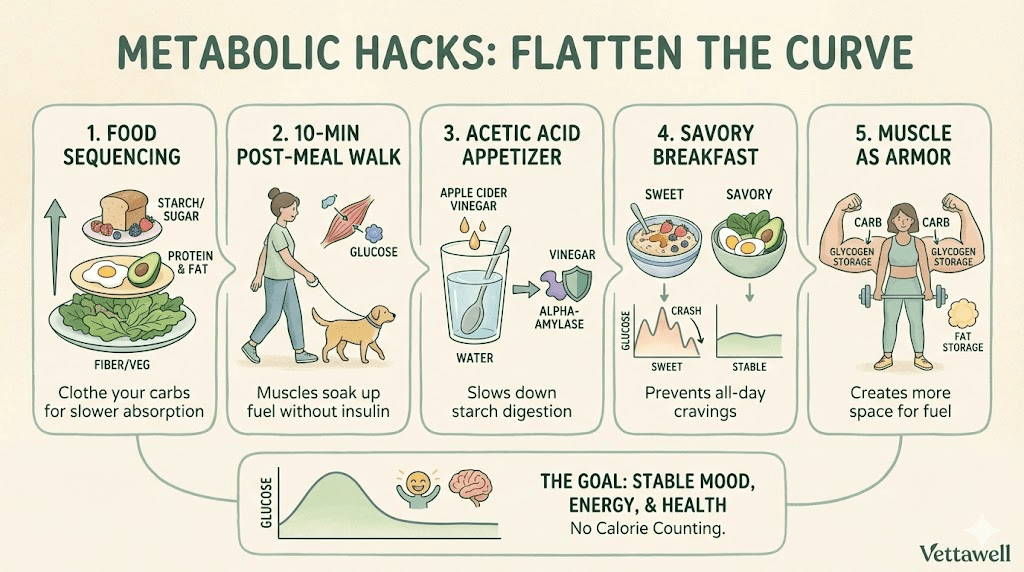
- Prioritize Protein to Build Muscle: Muscle is your 'metabolic sink.' The more you have, the more glucose you can dispose of safely. Aim for 30-50 grams of protein at every meal to trigger muscle protein synthesis.
- Move After You Eat: A simple 10-minute walk after your largest meal can significantly flatten your post-prandial glucose spike by using your large leg muscles to 'soak up' the sugar in your blood.
- Honor Your Circadian Rhythm: Your metabolism is significantly more efficient in the morning. Try to eat your larger meals earlier in the day and give your digestive system a 12-14 hour rest overnight.
- Manage the 'Invisible' Stress: Cortisol is a primary driver of gluconeogenesis (the body creating sugar from protein). If you are chronically stressed, your blood sugar will be high even if you aren't eating carbs. Prioritize 'down-regulating' activities like breathwork, journaling, or time in nature.
- Focus on Whole Food Structure: It's not just about the macros; it's about the matrix. Fiber is the 'security guard' of your gut, slowing down the absorption of sugar and feeding the microbiome that regulates your weight.
A Final Word: Breaking Free from the Scale
Breaking up with the scale is one of the most liberating things you can do for your health. When you stop using a single, deceptive number as your primary feedback loop, you open up the space to hear what your body is actually telling you. You start to value the strength in your legs, the clarity in your mind, and the stability of your mood. You begin to understand that your body is not an enemy to be shrunken, but a high-tech vehicle to be fueled, maintained, and respected.
In 2026, let us redefine what it means to be fit. Let us celebrate the metrics that truly correlate with a long, vibrant life. Your metabolic health is your most precious asset; don't let a bathroom accessory convince you otherwise. Focus on the internal symphony, and the external results will follow as a natural side effect of a body that is finally in harmony.