
Most of us were handed the “soulmate” story before we were old enough to question it: there is one person out there who will complete you, and once you find them, love should feel effortless. If it stops feeling effortless, the logic goes, you must have chosen wrong. This guide breaks down Forget "Soulmates": The 4 Types of Couples and the Formula for Lasting Love into the mechanisms that actually shape long-term outcomes—what couples do with their attention, their stress, their boundaries, and their repair.
Here’s the tricky part: the soulmate myth doesn’t just romanticize love—it raises the stakes of everyday conflict. A disagreement about chores becomes a referendum on compatibility. A dry spell becomes proof the spark is gone. Normal friction (misunderstandings, mismatched expectations, changing desire, parenting stress, money worries) starts to feel like evidence you “missed your person.” In reality, friction is often just the sound of two humans building a shared life.
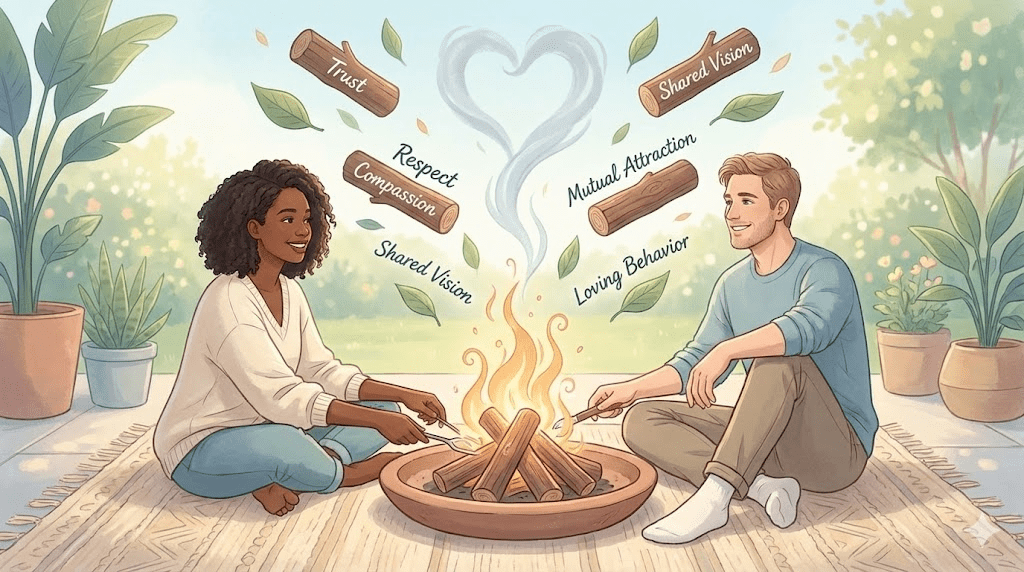
Dr. Sara Nasserzadeh—a social psychologist and therapist who has spent over two decades working with couples across many cultures—argues that the soulmate mindset limits our options and sets couples up for an avoidable kind of disappointment. Her alternative is a model called Emergent Love: love is less like a hidden treasure you find once and more like a fire you keep lit with the right ingredients. Remove an ingredient, and the fire weakens. Strengthen the ingredients, and love can emerge even after hard seasons.

A better question than “Is this my soulmate?”
Instead of asking whether your relationship “should” feel easy, a more useful question is: What are we feeding—intentionally or accidentally—in our relationship right now? Most couples don’t need a total reinvention. They need to stop starving the same few essentials.
- When we’re stressed, do we turn toward each other or away?
- Do we have a reliable way to repair after we get sharp, distant, or defensive?
- Are we building equity (flexible fairness) or keeping score?
Key takeaways
- “Emergent Love” frames love as something you create through ingredients—not something you either “have” or “don’t.”
- Couples often get stuck in patterns based on how they manage time, attention, energy, and money.
- The goal isn’t perfect fairness 24/7; it’s equity—a flexible sense of “we both matter here,” even when life is uneven.
- You can shift your dynamic with small maintenance habits: daily connection, clear boundaries, and fast repair.
- Long-term intimacy is less about constant chemistry and more about attunement—ongoing learning about each other.
Love isn’t a single discovery. It’s a system you build—and keep rebuilding—through small choices.
Why the soulmate story fails smart people
The soulmate myth isn’t “wrong” because romance is bad. It fails because it treats love like a static trait—like you either found the right person or you didn’t. That turns normal problems into existential threats. It also fuels comparison: if your relationship isn’t constantly intense, some part of you wonders whether you’re settling.
It also encourages mind-reading and unrealistic expectations: If we’re meant to be, my partner should just know what I need. But real partnership isn’t telepathy—it’s communication, adjustment, and repair. The couples who last aren’t the ones who never get disappointed; they’re the ones who recover quickly and keep investing in what matters.
Emergent love: the 6 ingredients
Think of love like a fire created by a log and a spark. Fire needs fuel and oxygen. In relationships, the “fuel” is a set of ingredients that keep warmth and stability alive. Dr. Nasserzadeh describes six non-negotiables. If one is missing, the relationship can still function—but it will often feel colder, more brittle, or more transactional.
- Mutual attraction: not only physical—also social, intellectual, and lifestyle fit (the kind of life you enjoy building).
- Trust: consistency over time—reliability, loyalty, and the ability to depend on your partner when it counts.
Attraction and trust are often what bring people together—and what makes them feel safe enough to stay when things get complicated. Attraction can evolve (and deepen) when you feel admired and chosen. Trust grows through repeated “proofs”: you show up, you follow through, you tell the truth, you handle shared money and responsibilities with integrity.
- Respect: honoring boundaries, values, and dignity—especially during conflict.
- Compassion: being present for your partner’s pain without turning it into your own performance or defensiveness.
Respect is what keeps disagreements from turning into humiliation. Compassion is what prevents “winning” from becoming more important than understanding. Many couples don’t fall apart because they stopped loving each other—they fall apart because contempt crept in, or because defensiveness became the default response.
- Shared vision: a commitment to “us” that persists even when you’re annoyed, tired, or stressed.
- Loving behavior: tenderness in words and touch, assuming good intent, and practicing repair after rupture.
Shared vision answers: What are we building together? Loving behavior answers: How do we make daily life feel safe and kind? These don’t show up once—they show up every day, in small ways: a warm greeting, a check-in, a fair handoff with the kids, a genuine apology.
Ask: Which two ingredients are strongest for us right now, and which two are most neglected? Most couples don’t need a complete overhaul—they need to stop starving one or two essential parts of the system. If you’re unsure, look for “signals”: Do you feel safe bringing up hard topics? Do you recover after conflict? Do you feel chosen?
The 4 couple patterns (and why they happen)
In Dr. Nasserzadeh’s work, couples often cluster into patterns based on how they manage shared resources—time, attention, energy, and money. The point isn’t to label yourself forever; it’s to name the pattern so you can change it intentionally. Most couples drift into these types during stressful seasons, not because they’re “bad at love.”
These couples focus heavily on fairness and balance. They view the relationship as an ongoing negotiation of power dynamics and labor—often striving for a strict 50/50 split. The upside is transparency. The downside is scorekeeping: who did more, who sacrificed more, who owes who.
- Common conflict theme: fairness (chores, emotional labor, money, parenting).
- Hidden risk: turning love into a ledger instead of a partnership.
- Useful pivot: replace “equal” with equitable—what’s fair changes week to week.
If this is you, the goal isn’t to abandon fairness. It’s to build flexibility: one partner may carry more during a hard work week, a health issue, or a family crisis, and the relationship stays stable because the system is built on trust, not tally marks.
These partners prioritize individuality and personal to-do lists. They manage resources independently, and the relationship receives whatever time and energy is “left over” after work, fitness, friends, kids, and obligations. Nothing is necessarily wrong—but the relationship becomes underfed.
- Common conflict theme: neglect (feeling like a low priority).
- Hidden risk: drifting apart without a big fight—just distance.
- Useful pivot: schedule connection like it matters, because it does.
You don’t drift into closeness. You drift into distance—unless you build habits that pull you back together.
Often romanticized in pop culture, this dynamic involves two people who feel they “can’t live without” each other. It can feel intense and beautiful early on—like constant closeness equals love. Over time, it may lead to codependency, loss of self, and a suffocating lack of boundaries.
- Common conflict theme: control (jealousy, reassurance loops, fear of separation).
- Hidden risk: confusing attachment anxiety with devotion.
- Useful pivot: strengthen boundaries and rebuild individuality inside the relationship.
If this resonates, start gently: name the difference between intimacy and enmeshment. Healthy love includes space—friends, interests, quiet time, and autonomy—without punishment or withdrawal.
This is the goal: two independent people in an interdependent partnership. They maintain healthy boundaries and treat the relationship as a distinct entity they both contribute to and receive from. In this dynamic, equity replaces strict fairness, and love tends to emerge naturally because the system is well-fed.
- Repair after conflict happens fast and respectfully (even if the issue isn’t solved yet).
- Identity feels balanced: “me + you + us.”
- Connection rituals survive busy seasons (not just vacations).
- Both partners feel safe bringing up hard topics without ridicule or punishment.
How to build emergent love (without making it a full-time job)
Moving toward an emergent dynamic doesn’t require grand gestures. It requires maintenance—small, repeatable practices that keep trust, respect, and compassion from eroding. Two tools Dr. Nasserzadeh highlights are simple but powerful: a daily emotional check-in and an intentional shift from chemistry to long-term harmony.
- Connect: one warm bid for attention (eye contact, touch, a genuine question).
- Update: share one “headline” from your day—what mattered most.
- Name: one small need or boundary for the next 24 hours (sleep, space, help).
- Appreciate: one specific thing you noticed and valued.
- Repair: if tension exists, do a short reset (even a 30-second apology helps).
Many couples separate because they drift, not because of one dramatic betrayal. To prevent drift, practice a daily check-in where each person shares one “oy” (something heavy on your heart) and one “joy” (something that made you smile). Keep it short. The goal isn’t to solve everything—it’s to stay emotionally updated.
- Rule of thumb: listen first, fix second (and only if invited).
- If you’re already escalated, pause and do repair—then return to the check-in.
- If you’re busy, do it in 3 minutes anyway; consistency beats perfection.
Try: “My oy is I feel stretched thin. My joy is you made me laugh today.” Then stop. Let the other person go.
Couples who last aren’t conflict-free; they’re repair-skilled. A simple repair script can interrupt spirals before they harden into resentment. Pick phrases that sound like you, and use them early—before you’re too flooded to be kind.
- “I got sharp. I’m sorry.”
- “I think we’re missing each other—can we restart?”
- “Help me understand what you meant.”
- “I’m feeling defensive. Give me two minutes and I’ll come back.”
- “You matter to me more than being right.”
Sexual chemistry often fizzles if it’s treated like a self-sustaining spark. Many couples can transform the spark into sexual harmony through attunement—a mutual awareness and continuous learning about one another. Harmony isn’t constant fireworks; it’s a shared understanding of what feels good, what feels safe, and what helps each partner stay connected over time.
Attunement can be practical: checking in about desire without pressure, noticing how stress and sleep affect your bodies, and making room for affection that isn’t a transaction. The goal is to keep intimacy adaptive instead of stuck in “how it used to be.”
- Do a no-pressure intimacy check-in: “More, less, or same this week?”
- Trade specifics, not guesses: “I liked when you…” and “I miss when we…”
- Protect one window for closeness (even 20 minutes) where phones are out of reach.
A one-week experiment to shift your pattern
If you want change without overwhelm, run a short experiment. The point is not to prove who’s right; it’s to gather data about what improves connection in your specific relationship.
- Day 1: Identify your pattern (Contemporary/Leftover/Submergent/Emergent) and say it neutrally: “We’ve been acting like a Leftover couple lately.”
- Day 2: Do the Oy & Joy check-in once.
- Day 3: Add one boundary that protects the relationship (example: one phone-free meal).
- Day 4: Use one repair phrase the first time tension shows up.
- Day 5: Do one shared activity that’s small but connecting (walk, coffee, 20-minute show).
- Day 6: Talk about shared vision for 10 minutes: “What do we want the next 3 months to feel like?”
- Day 7: Review: what made us feel closer, and what drained us?
Practical next steps
- Name your current pattern and one trigger that pushes you into it (stress, workload, resentment, insecurity).
- Choose two ingredients to strengthen for the next 30 days (example: trust + loving behavior).
- Use short, frequent check-ins instead of one long “big talk.”
- Create one boundary that protects connection (time/place/purpose for devices).
- Practice repair early—before sarcasm, withdrawal, or blame take over.