"My Ovaries Weren't Broken, My Metabolism Was": How Sarah Reversed Her PCOS Without the Pill
This guide breaks down "My Ovaries Weren't Broken, My Metabolism Was": How Sarah Reversed Her PCOS Without the Pill into the key mechanisms and the decisions that matter in practice. At 27, I felt like a teenager in the worst way possible—jawline acne, thinning hair, and a body that seemed to gain weight on "healthy" food.
The pill didn’t fix why my body was malfunctioning—it just muted the alarm.
Key takeaways
- PCOS is often a metabolic and hormonal signaling issue—not just an “ovary problem.”
- For many women, insulin resistance is the upstream driver that amplifies ovarian androgens and blocks ovulation.
- The fastest wins usually come from breakfast, protein targets, and lowering glucose volatility—not from extreme restriction.
- Progress is measured in symptoms and biomarkers (cycle quality, acne, energy, cravings), not just the scale.
- Sustainable results require an “exit strategy” from stress: sleep, training volume, and recovery matter as much as food.
The 10-Minute Appointment
At 27, I felt like a teenager in the worst way possible. I had deep, painful cystic acne along my jawline. My hair was thinning at the temples. And despite eating "clean" (fruit smoothies, salads, low-calorie wraps), I had gained 15 pounds in a year that wouldn’t budge.
I went to my gynecologist hoping for answers. The appointment lasted ten minutes. She looked at my irregular cycle history and the ultrasound showing "cysts" (follicles) on my ovaries. "You have PCOS (Polycystic Ovary Syndrome)," she said. "Here is a prescription for birth control pills. It will clear up the acne and regulate your bleed. Come back when you want to get pregnant."
I walked out with the prescription, but I felt defeated. The pill wasn’t fixing the root cause; it was turning off the alarm system. I didn’t want to mask the symptoms. I wanted to heal.
The Missing Link
I decided to treat myself like a science experiment. I started tracking my symptoms, my meals, my sleep, and how my body responded. What I found was uncomfortable: my "healthy" habits were reliably triggering my worst days.
- Fruit smoothies: “clean” on paper, but functionally a sugar bolus without fiber or protein.
- Low-calorie wraps and salads: often too little protein, leaving my appetite unstable and my cravings loud.
- Hard training: high-intensity classes that made me feel virtuous—while quietly inflaming my stress response.
Then I found a term that changed everything: insulin resistance. I learned that for many women with PCOS, the problem isn’t primarily in the ovaries—it starts in the pancreas, the liver, the muscle cells, and the nervous system.
PCOS Is a Syndrome, Not a Single Disease
PCOS isn’t one uniform condition. It’s a label that describes a pattern: irregular ovulation + higher androgens + ovarian follicles that don’t mature as expected. Different women arrive at that pattern via different pathways.
- Insulin-driven PCOS: the most common clinical pattern—energy storage and elevated insulin amplify ovarian androgen output.
- Stress-driven pattern: chronic cortisol and sleep disruption worsen insulin signaling and cycle regularity.
- Inflammation-driven pattern: gut issues, ultra-processed foods, or persistent inflammation can exacerbate hormone imbalance.
- Post-pill rebound pattern: some women notice symptoms flare after stopping hormonal contraception.
This matters because a single solution (like “just take the pill”) doesn’t address the real driver for every woman.
Here Is the Chain Reaction I Discovered
- Step 1: High insulin: My cells weren’t responding to insulin efficiently, so my body pumped out more to keep blood sugar stable.
- Step 2: Ovarian hijack: Elevated insulin can signal the ovaries to overproduce androgens (including testosterone).
- Step 3: Ovulation disruption: Excess androgens interfere with follicle maturation—ovulation becomes irregular or disappears.
- Step 4: Symptoms: acne, hair thinning, cravings, and weight gain become downstream effects of the signaling chaos.
Once I saw PCOS as a metabolic signaling issue, my strategy shifted from “fight my body” to “stabilize the system.”
Why "Clean Eating" Wasn’t Helping
I had been eating “healthy foods,” but I wasn’t eating in a way that stabilized my glucose and insulin. Many “clean” meals are still high-glycemic when they’re low in protein, low in fat, and eaten in isolation.
- Smoothie problem: liquid calories absorb quickly; even fruit-only smoothies can spike glucose.
- Low-fat trap: removing fat often increases carbs; satiety drops and snacking rises.
- Protein gap: if breakfast is sweet and protein-light, cravings become a predictable outcome.
The 90-Day "Metabolic Reset" Plan
I didn’t chase perfection. I chased repeatable signals: fewer cravings, better sleep, more stable mood, and signs of ovulation returning. I built a 90-day plan with three priorities: blood sugar stability, stress reduction, and muscle preservation.
- Priority #1: Flatten glucose spikes (especially in the morning).
- Priority #2: Reduce training stress (swap intensity for consistency).
- Priority #3: Build muscle (the biggest “sink” for glucose disposal).
Intervention 1: The Breakfast Switch
My morning smoothie was pure sugar (especially fructose) with almost no satiety. I replaced it with a savory, protein-forward breakfast and treated the first meal as a metabolic steering wheel.
- Old: banana + berries + oats blended into a “healthy” smoothie.
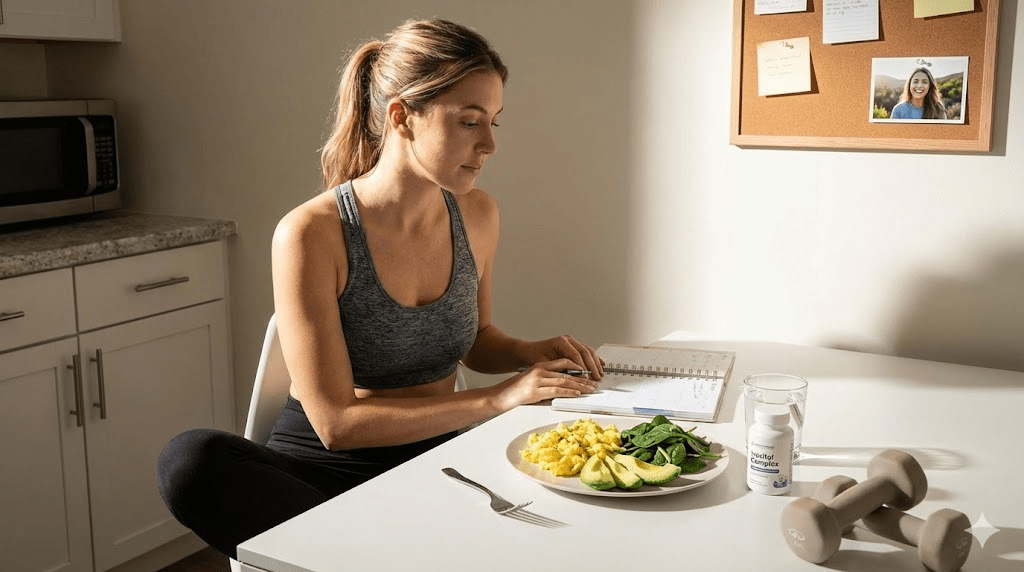
- New: eggs with greens + half an avocado (or Greek yogurt + nuts if I needed convenience).
- Why it worked: protein and fat reduce glucose volatility; a stable morning often creates a stable day.
Within two weeks, my cravings softened. The “snack voice” in my head got quieter—not because I became more disciplined, but because my insulin swings reduced.
Intervention 2: Food Rules That Didn’t Feel Like Punishment
I didn’t count calories. I made three rules that were simple enough to follow when I was busy.
- Protein anchor: include a meaningful protein source at every meal.
- Carbs with clothing: never eat “naked carbs” (pair starch with protein + fiber).
- Dessert timing: if I wanted something sweet, it happened after a meal—not as breakfast or a standalone snack.
This wasn’t about restriction; it was about predictable physiology. My energy became smoother, and my mood stopped living on a rollercoaster.
Intervention 3: Walking, Not Running
I stopped treating exercise as punishment. High-intensity classes made me feel like I was “doing the work,” but they also spiked stress, especially when paired with undereating or fasting.
- Post-meal walks: 10–15 minutes after meals to use muscles as a glucose sink.
- Zone 2 base: steady walking or cycling a few times per week for metabolic health.
- Strength work: slower, heavier lifts 2–4 times per week to build insulin-sensitive tissue.
The result was counterintuitive: doing “less” intensity produced more hormonal stability. I felt calmer, slept better, and stopped craving sugar after stressful days.
Intervention 4: Sleep and the Stress "Amplifier"
PCOS symptoms don’t exist in a vacuum. When sleep is short or fragmented, insulin resistance worsens and appetite signals become chaotic. I treated sleep as part of the protocol, not a bonus.
- Fixed wake time: consistent wake time most days (even on weekends when possible).
- Caffeine cut-off: no late caffeine that sabotages deep sleep.
- Evening downshift: lights dimmer, screens earlier, and a “transition ritual” before bed.
The Supplement Piece (Optional, Not Magical)
I avoided supplement overload. If I used anything, it supported the plan rather than replacing it. I discussed choices with a clinician because supplements can be inappropriate for some people and situations.
- Myo-inositol + D-chiro-inositol (commonly studied in a 40:1 ratio): often used to support insulin signaling in PCOS.
- Magnesium glycinate: used by many for sleep quality and nervous system support.
- Vitamin D (if low): deficiency is common and can worsen metabolic health.
The point wasn’t to “hack” my body. It was to remove friction from good habits long enough for the biology to respond.
What Improved First (And What Took Time)
Progress didn’t arrive as a dramatic moment. It arrived as a slow reclaiming of normal.
- First 2–3 weeks: cravings reduced; afternoon energy stabilized; sleep became less fragile.
- Month 2: acne inflammation softened; facial puffiness decreased; workouts felt easier to recover from.
- Month 3–4: cycle signs returned (cervical mucus, mood shifts, more consistent timing).
- Month 4+: the period returned in a more “natural” rhythm—this became the real signal that the system was recalibrating.
The Outcome
It wasn’t an overnight miracle. For three months, nothing obvious happened and I almost quit. But in month four, I got my period—a real, natural period, my first one in a long time. By month six, the acne along my jawline began to fade. By month nine, the “puffy” look in my face was gone and my weight normalized without obsessive tracking.
I realized my body wasn’t broken. It was communicating. Once I changed the fuel and lowered the stress signal, the machine started working again.
When to Get Labs or More Support
PCOS intersects with thyroid function, anemia, sleep disorders, and other issues that can mimic or amplify symptoms. If symptoms are severe, persistent, or worsening, clinical evaluation matters.
- Ask about metabolic markers (fasting glucose/insulin, lipids, A1c) and androgen-related labs when appropriate.
- Consider thyroid screening if fatigue, hair loss, or weight changes are disproportionate.
- If cycles are absent for long periods, discuss endometrial health and risk management with a clinician.
Practical next steps
- Track symptoms and cycle timing for 8–12 weeks to identify patterns.
- Start with breakfast: choose a savory, protein-forward option for 14 days and observe cravings/energy.
- Add 10–15 minutes of walking after your two largest meals for the next 2 weeks.
- Schedule strength training 2–3 times per week (full-body, progressive, sustainable).
Common pitfalls
- Treating PCOS like a willpower problem instead of a signaling problem.
- Over-training while under-eating (a perfect recipe for cortisol + insulin chaos).
- Switching protocols every week and never staying consistent long enough to see hormonal change.
- Using supplements as the main strategy while ignoring sleep, protein, and movement.
Quick checklist
- Breakfast contains protein + fat (not sugar-first).
- Most meals have a protein anchor and fiber.
- Post-meal movement happens often (even 10 minutes counts).
- Strength training is scheduled, not optional.
- Sleep has a plan (wake time + downshift routine).