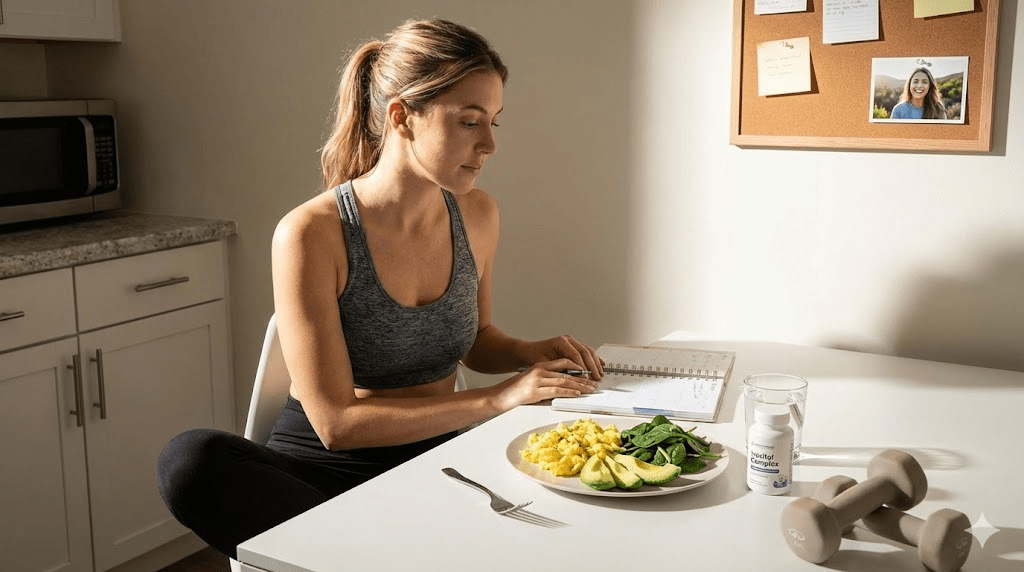
“The World Runs on a 24‑Hour Clock, You Don’t”: Why Female Productivity Cannot Be Linear
This guide breaks down “The World Runs on a 24‑Hour Clock, You Don’t”: Why Female Productivity Cannot Be Linear into the key mechanisms and the decisions that matter in practice. If you’ve ever felt like you’re “two different people” in the same month, you’re not imagining it.
One week you feel sharp, social, and unstoppable. Another week the same tasks feel heavy, your patience is thinner, and your body seems to demand quieter inputs. Most women respond with self-criticism (“I’m inconsistent”), but the more accurate diagnosis is physiological variability.
The problem isn’t your discipline. The problem is the assumption that your energy should be flat.
Key takeaways
- Female output is governed by an infradian rhythm (multi‑week), not just a circadian rhythm (24‑hour).
- Your cycle creates predictable “windows” for starting, performing, finishing, and recovering—if you track it.
- Cycle‑aware planning is not doing less; it’s matching the right type of work to the right biological state.
Why linear productivity fails women
Modern work culture was engineered around a body that resets hormonally every morning. That’s not a moral judgment; it’s an operating-system mismatch. The result is that many women run a “male schedule” on a “female firmware,” and then blame themselves for lag.
- Men (typical pattern): Primarily circadian (24 hours). Testosterone peaks earlier in the day and gradually declines, creating a daily reset and more stable week-to-week output.
- Women (typical pattern): Infradian (roughly 21–35 days for many). Estrogen, progesterone, LH/FSH shift across the month, meaning cognition, recovery capacity, and stress reactivity can change week by week.
This is why “do the same workout at the same intensity every day” and “schedule the biggest pitch every Monday” works beautifully for some bodies—and burns others out.
Cycle syncing isn’t a vibe. It’s resource allocation
The goal is not to micromanage your life. The goal is to make fewer high-cost decisions when your system is more vulnerable to stress, inflammation, or poor sleep, and to use high-output windows strategically.
- Think of your cycle like seasons: you don’t wear the same clothes in January and July. You also shouldn’t expect the same social load, training load, or meeting density in every phase.
- Cycle-aware planning: builds a plan where your “hard weeks” are designed, not accidental.
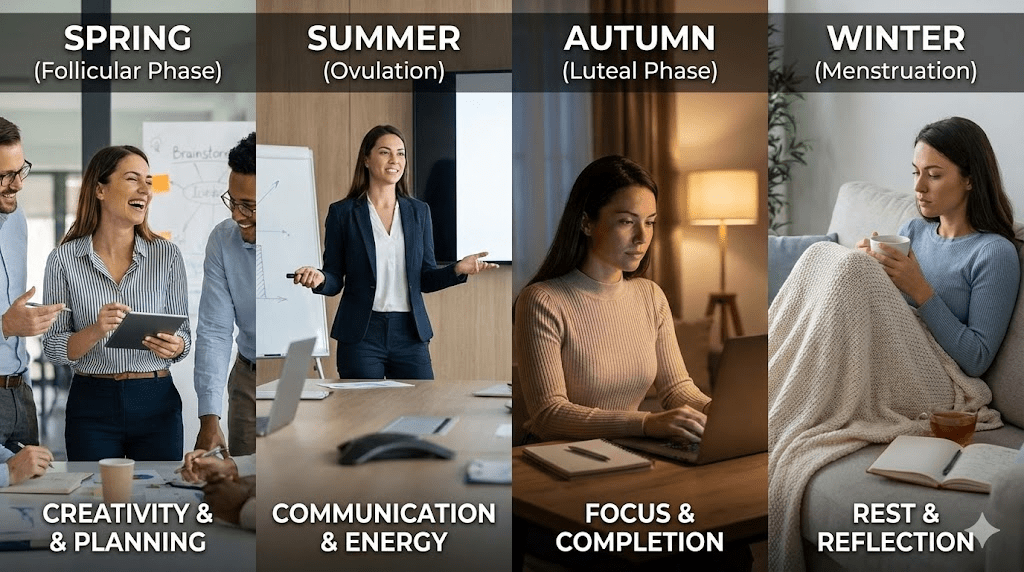
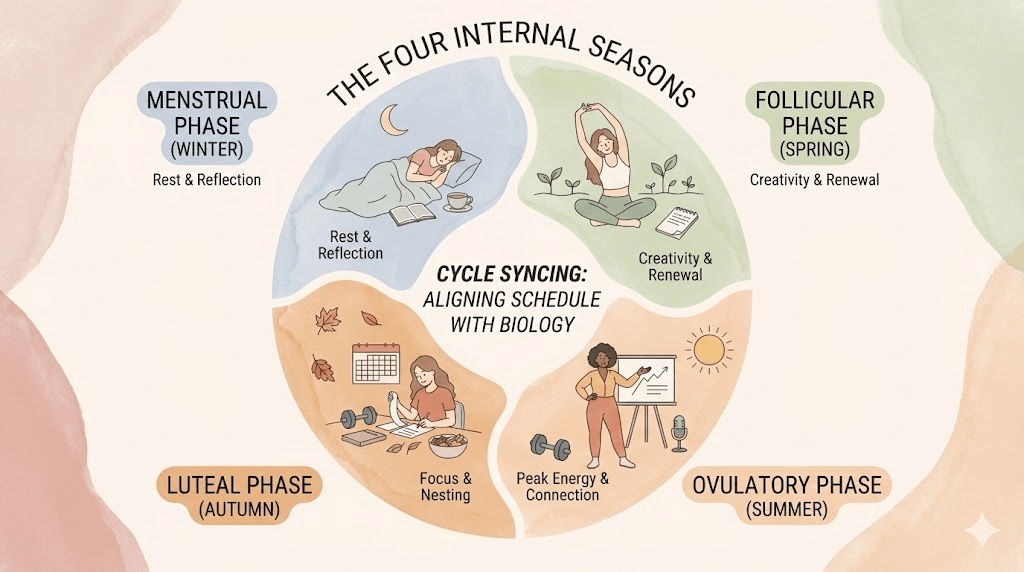
The four seasons of your productivity
While every body is individual, many women notice consistent patterns once they track for 2–3 cycles. Below is a practical mapping you can use as a starting point. Adjust based on your real data, not a textbook timeline.
Biological Winter (Menstruation)
When bleeding begins, both estrogen and progesterone are at their lowest baseline. Many women experience lower physical stamina and a stronger pull toward introspection—especially on days 1–2.
- Work best for: review, reflection, auditing, prioritization, “what do I want?” decisions.
- Energy strategy: reduce meeting density; protect deep rest; shorten social obligations.
- Training: walking, mobility, light resistance, yoga; keep intensity optional.
- Nutrition focus: iron-rich foods + vitamin C pairing; hydration; steady protein.
Winter questions are often simple and sharp: “Am I going in the right direction? Do I like my life?”
Biological Spring (Follicular Phase)
After menstruation, estrogen rises and many women report improved mood, faster learning, and higher willingness to try new things. This is a strong “initiation” window.
- Work best for: starting projects, pitching ideas internally, creative ideation, learning, onboarding new routines.
- Energy strategy: schedule collaboration; batch “new” tasks; set the month’s top 3 outcomes.
- Training: progressive overload feels easier; you may tolerate higher intensity better.
- Nutrition focus: carbs tend to be handled well for many women; still anchor meals with protein/fiber.
Biological Summer (Ovulation)
Around ovulation, estrogen is high and there is often a short testosterone bump. Many women feel more verbal, confident, and socially open. This phase is built for external output.
- Work best for: high-stakes presentations, negotiations, interviews, networking, difficult conversations.
- Energy strategy: put the “visibility” tasks here—record videos, do demos, host meetings.
- Training: HIIT and heavier sessions may feel best here; recovery is often higher.
- Watch-outs: some women feel ovulation pain or migraines—your real pattern is the authority.
Biological Autumn (Luteal Phase)
After ovulation, progesterone rises and estrogen dips, shifting many women toward detail-orientation, pattern detection, and a lower tolerance for chaos. This is the completion phase.
- Work best for: editing, quality control, finishing deliverables, admin cleanup, deep solo work.
- Energy strategy: reduce decision fatigue—use checklists, templates, and fewer meetings.
- Training: consider slightly lower intensity or more strength/pilates; add recovery buffers.
- Nutrition focus: appetite often increases; plan protein-forward snacks and steady meals to reduce cravings.
What gets labeled as “PMS personality” is often a nervous system signal: too much stimulation, too little recovery, and a calendar that ignores biology.
How to build a cycle-aware calendar in 20 minutes
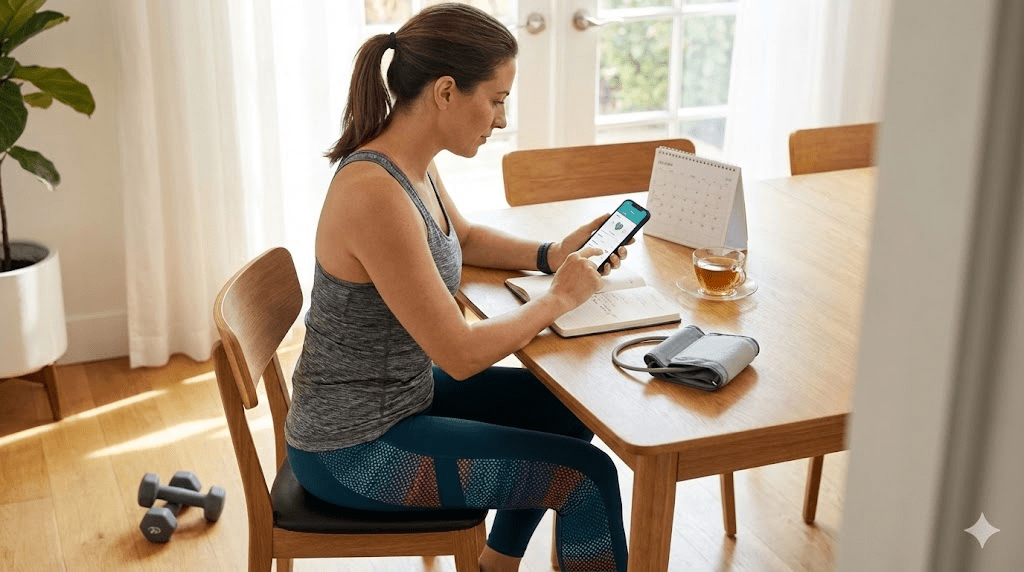
- Step 1 — Track the only two variables that matter: cycle day + symptoms (sleep, mood, focus, cravings, training tolerance). Keep it simple for 8–12 weeks.
- Step 2 — Identify your “high-output” window: the days you reliably feel more social/verbal/energetic. Protect it for external deliverables.
- Step 3 — Identify your “completion” window: the days you reliably feel more detail-driven. Put editing, operations, and cleanup there.
- Step 4 — Build a recovery policy: decide in advance what gets reduced in your lowest-energy days (meetings, HIIT, late nights).
Workplace scripts that reduce friction
You don’t have to explain your hormones to anyone. You can frame cycle-aware planning as performance management and scheduling hygiene.
- Meeting boundary: “I’m best for deep work in the mornings this week—can we push this to Thursday afternoon?”
- Deadline strategy: “I can deliver a stronger V1 by Wednesday, then final polish Friday.”
- Social load: “I’m heads-down on execution this week. Next week I’m open for brainstorms.”
If your cycle isn’t “textbook”
Irregular cycles, hormonal contraception, perimenopause, postpartum, and PCOS can all change timing and patterns. The method still works—because it’s based on your observed data, not a calendar app’s prediction.
- If you’re on hormonal contraception: track symptoms (sleep, energy, mood) even if bleeding is scheduled; your body still has rhythms.
- If you’re perimenopausal: the “seasons” may feel less predictable; focus on recovery capacity and sleep quality as the primary levers.
- If you’re postpartum: treat energy like a scarce resource—build micro-wins, not “perfect routines.”
Red flags that aren’t “just hormones”
- Bleeding that is extremely heavy, prolonged, or accompanied by fainting.
- Severe mood symptoms or panic that feel unsafe or unmanageable.
- Cycle-related pain that disrupts work or sleep consistently.
- A sudden major change in cycle pattern that persists for 2–3 cycles.
Cycle-aware productivity is not a substitute for medical care. If symptoms are severe or escalating, treat that as actionable clinical data, not something to “push through.”
The new paradigm
A linear world rewards repeatable output. A cyclical body rewards timing, recovery, and strategy. When you plan with your biology instead of against it, you don’t lose ambition—you gain sustainability. The goal is not to be “on” every day. The goal is to win the month.
Practical next steps
- Track cycle day + 3 symptoms (sleep, mood, focus) for 8–12 weeks to find your real pattern.
- Schedule one “visibility” task in your likely Summer window and one “cleanup” task in your likely Autumn window.
- Create a Winter rule: reduce meetings, reduce HIIT, increase sleep buffer for the first 48 hours of bleeding.
Common pitfalls
- Using cycle syncing as a reason to quit—rather than as a way to plan smarter.
- Copying someone else’s “perfect” phase schedule instead of tracking your own responses.
- Treating late-luteal cravings as a willpower failure instead of a planning problem (meal timing/protein).
Quick checklist
- Cycle data is logged consistently (even if just 30 seconds/day).
- Weekly plan includes at least one recovery buffer.
- Training includes resistance work, but intensity flexes across the month.
- Sleep is protected during high-symptom days.
- You have one simple script to move meetings when needed.