Stop Fighting Your Biology: Why You Should Quit HIIT Workouts Before Your Period
In the corporate and fitness worlds, consistency is king. We’re told to wake up at the same time, hit the same macros, and crush the same workout intensity every single day—no excuses. The message is clear: if you’re tired, you’re weak. If you’re not progressing, you’re not disciplined.
But that “always-on” model quietly assumes a body that resets the same way every 24 hours. Many women don’t experience physiology that neatly. Energy, recovery, appetite, and stress reactivity can shift across the month—especially in the week or two before bleeding. If you try to train like it’s always your highest-energy window, you may end up with plateaus, nagging injuries, poorer sleep, and the feeling that your body is working against you.
Discipline isn’t doing the same thing every day. Discipline is doing what moves you forward—even when your body’s inputs change.
Key takeaways
- Women often experience an infradian rhythm (multi-week cycle) that can influence recovery, energy, and perceived exertion.
- The “week before your period” is commonly when sleep, temperature, cravings, and stress reactivity shift—making HIIT feel harder for many people.
- You don’t need to stop training. You often need to change the training signal (volume, intensity, or type).
- The goal is not perfection or rigid “cycle rules”—it’s autoregulation: matching your workout to your current capacity.
- Cycle-aware training works best when paired with tracking: sleep, mood, soreness, and performance (not just the scale).
First: a reality check on cycles and individuality
Not everyone has a textbook 28-day cycle, and not everyone feels the same in each phase. Hormonal contraception, perimenopause, postpartum recovery, PCOS, thyroid issues, and chronic stress can all change patterns. The point of cycle-aware training is not to declare one “right” schedule—it’s to notice how your body responds, then adjust intelligently.
Think of this approach as a performance framework: track → interpret → adapt. If the week before your period consistently comes with poorer sleep, higher irritability, or heavier legs, it may be the wrong time for repeated all-out intervals.
Circadian vs. infradian: why the “same every day” model can misfit
Men are often described as operating strongly on a circadian (24-hour) cycle, while many women experience additional infradian (multi-week) shifts tied to reproductive hormones. In plain language: your body may not deliver the same readiness every morning, even when you “did everything right.”
What changes for many women pre-period
- Higher perceived exertion: the same workout can feel harder even if your fitness hasn’t changed.
- Sleep disruption: more awakenings or lighter sleep can reduce recovery capacity.
- Temperature shifts: some women feel warmer, which can reduce tolerance for maximal efforts.
- Appetite and cravings: fuel needs can rise; under-eating can backfire.
- Stress sensitivity: pushing maximal intensity can feel more “costly” (more irritability, more soreness).
If your recovery budget is smaller, “max intensity” spends it faster.
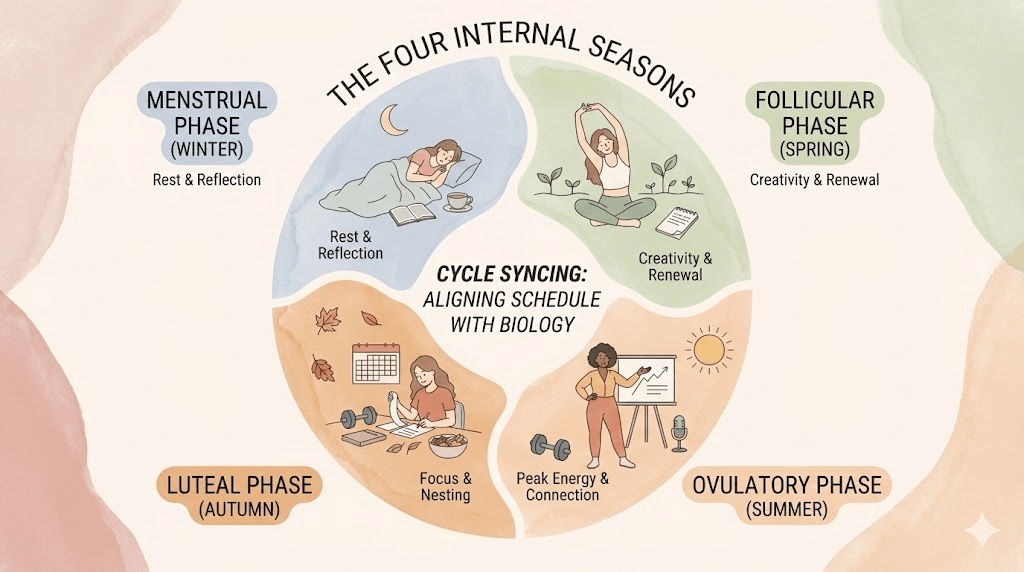
The four internal seasons (a useful lens, not a strict rulebook)
Some functional medicine and performance coaches describe the menstrual cycle as four “seasons.” It’s a helpful mental model: different phases can favor different kinds of output. Use this as a starting hypothesis, then let your tracking confirm what’s true for you.
Menstrual phase (Winter)
For many, this is a lower-energy window—especially on Day 1–2. It can also be a reset: inflammation and cramps may be higher, and sleep can be variable.
- Training signal: walking, mobility, gentle strength, or restorative yoga.
- Work signal: review, planning, analysis; lower social output if you feel inward.
- Support: hydration, iron-rich foods if relevant, and more sleep opportunity.
Follicular phase (Spring)
As the body moves away from bleeding, many women notice improving mood, sharper focus, and better training tolerance. It can be a good time for skill-building and progressive overload.
- Training signal: strength progressions, moderate-to-hard conditioning, learning new movement patterns.
- Work signal: brainstorming, strategic work, initiating projects.
- Support: balanced carbs around training can feel easier to tolerate for many.
Ovulatory phase (Summer)
This is often described as a short peak window—when confidence, social energy, and performance feel high. Not everyone experiences it dramatically, but many report stronger training sessions and a higher tolerance for intensity.
- Training signal: heavier lifting, speed work, HIIT (if you enjoy it), challenging group sessions.
- Work signal: presentations, negotiations, networking, high-collaboration days.
- Support: warm-up well and manage joint integrity if you’re prone to tweaks.
Luteal phase (Autumn)
This is the phase that often gets people into trouble—not because it’s “bad,” but because many try to maintain summer-level intensity while their recovery capacity changes. In the later luteal days, PMS symptoms may show up and sleep can worsen.
- Training signal: strength with slightly lower intensity or volume, zone 2 cardio, Pilates, technique work, and more recovery days.
- Work signal: detail-oriented work, organization, finishing tasks, deep solo focus.
- Support: stabilize blood sugar (regular meals, protein + fiber), reduce late-night work, and keep caffeine earlier.
So why quit HIIT before your period?
HIIT is a powerful tool: it delivers a strong stimulus in a short time. The downside is that it’s also a high-cost signal—it asks a lot from the nervous system, sleep, and recovery. If your body is already trending toward higher stress sensitivity or lower sleep quality, that cost can outweigh the benefit.
The result can look like “I’m doing everything right and nothing is working.” In reality, the training load is mismatched to the moment. You’re not failing discipline—you’re mismanaging timing.
Signs HIIT is the wrong move this week
- You’re sleeping worse and waking up unrested (especially multiple nights in a row).
- Your resting heart rate feels higher than usual or you feel unusually wired.
- The warm-up feels hard and your legs feel heavy early.
- You’re more irritable, anxious, or emotionally “thin-skinned.”
- You recover slowly (DOMS lasts longer, you feel sore for days).
If your warm-up feels like the workout, your body is already telling you the answer.
What to do instead (without losing progress)
Quitting HIIT pre-period does not mean quitting training. It means switching to a stimulus that supports performance next week rather than punishing your system this week.
Option 1: Zone 2 cardio (the underrated upgrade)
Zone 2—steady, conversational pace—can improve aerobic base and recovery capacity while keeping stress load manageable. It’s a strong choice when you want movement without nervous-system strain.
Option 2: Strength training, but “lighter and cleaner”
- Reduce volume: fewer sets, leave 2–3 reps in reserve.
- Prioritize technique: slower tempo, controlled reps, strong form.
- Swap maximal lifts for moderate loads (or machines if joints feel sensitive).
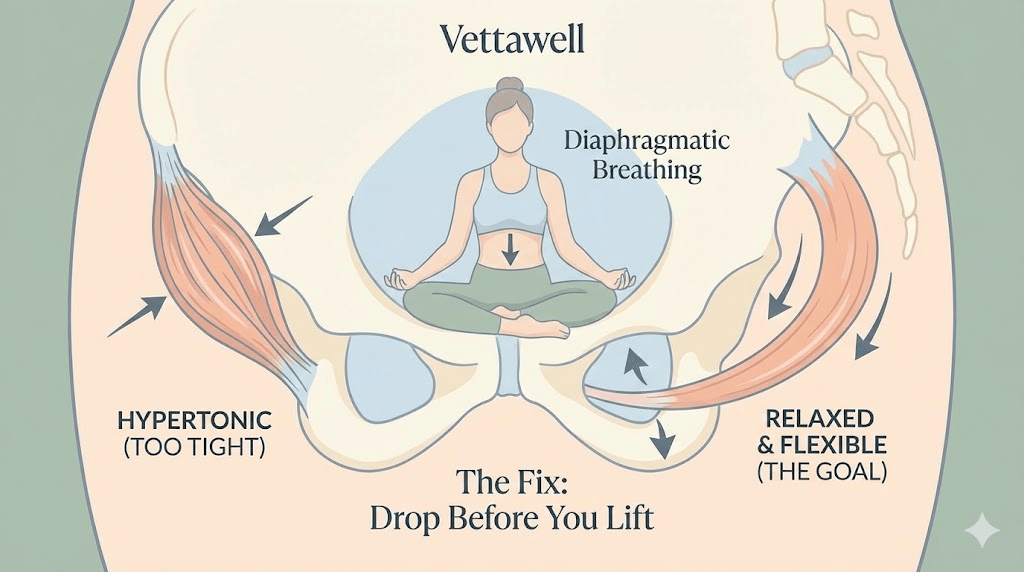
Option 3: Pilates, mobility, and core coordination
This is an excellent phase to invest in movement quality: hip stability, trunk control, and mobility. These sessions can reduce aches and improve your ability to hit intensity when you return to it.
Option 4: “Intervals, but not HIIT”
If you love intervals, downgrade intensity instead of abandoning the format. Think: short efforts that feel challenging but not maximal, with longer recoveries. Your goal is to finish feeling energized, not wrecked.
The consistency myth (and a better definition)
The myth is that consistency means identical effort every day. In reality, elite training cycles intensity. They have hard days, easy days, build phases, and deload phases. Cycle-aware training is simply a biological version of that same intelligence.
When a woman in late luteal phase forces a 6 AM boot camp because “discipline is key,” she may amplify stress and inflammation rather than adapting. Cycle syncing isn’t about doing less. It’s about doing the right thing at the right time.
Consistency is not sameness. Consistency is showing up with the correct dose.
A simple 28-day training rhythm (customize it)
If you want an easy structure, try this as a starting point. Adjust based on your data and how you feel.
- Menstrual (Days 1–3): 2–4 easy sessions (walks, mobility, gentle strength).
- Follicular (Days 4–10): progressive overload in strength + 1–2 harder conditioning sessions.
- Ovulatory (Days 11–14): your hardest sessions if you want them (HIIT, heavier lifts).
- Luteal (Days 15–28): maintain strength with slightly reduced volume + zone 2; reduce maximal intensity in the final 7–10 days.
Common pitfalls
- Treating cycle syncing as a rigid rulebook instead of a feedback system.
- Ignoring nutrition in late luteal phase and under-eating while pushing intensity.
- Doubling down on HIIT when sleep is poor, then blaming “lack of willpower.”
- Assuming severe symptoms are “normal”—if symptoms are debilitating, consider clinical evaluation.
- Forgetting that contraception, perimenopause, and stress can change patterns and require a different approach.
Practical next steps
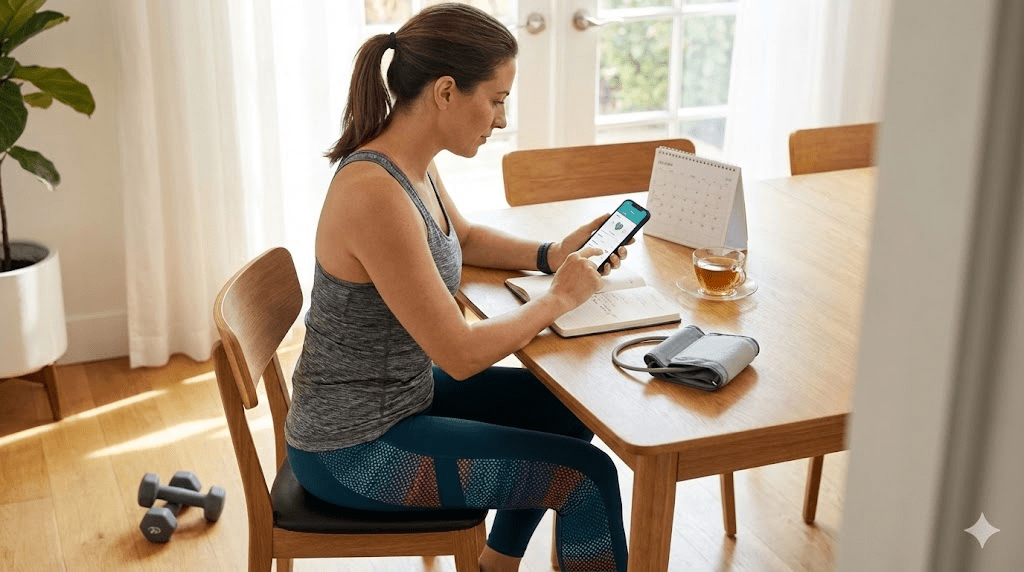
- Track symptoms and cycle timing for 8–12 weeks (sleep, energy, mood, cravings, training performance).
- In the final 7–10 days before bleeding, replace HIIT with zone 2, technique strength, or Pilates for one cycle and compare outcomes.
- Use a readiness check: if warm-up feels hard, reduce intensity and prioritize movement quality.
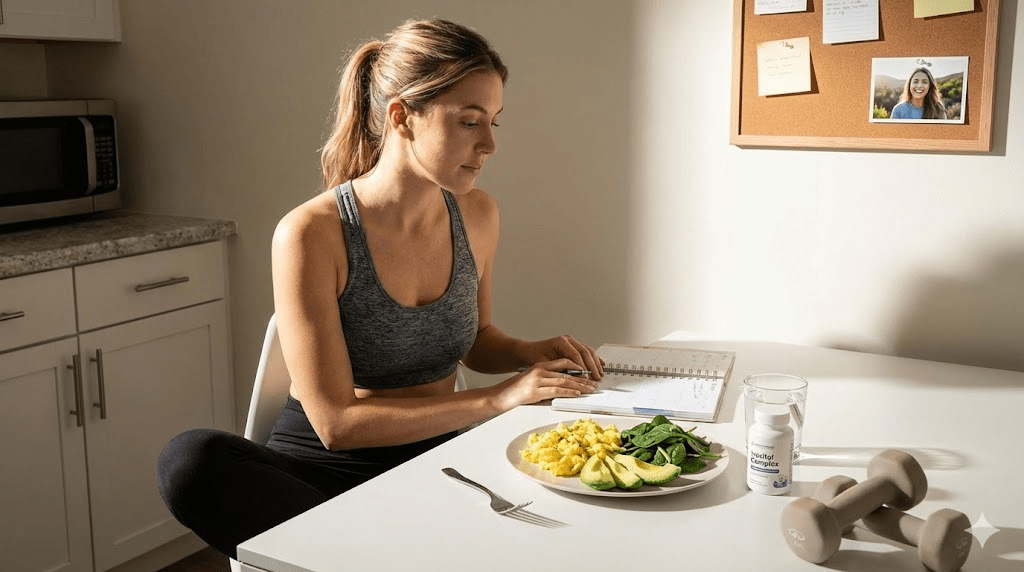
- Stabilize basics late luteal: protein + fiber, hydration, earlier caffeine cutoff, and a consistent wind-down routine.
- If symptoms are severe (pain, heavy bleeding, fainting, extreme mood changes), work with a qualified clinician.
Quick checklist
- I know where I am in my cycle (or I’m tracking to learn).
- I can name my late-luteal pattern (sleep, cravings, energy) without guessing.
- I swap HIIT for a lower-cost stimulus when readiness is low.
- My training includes both intensity and recovery (not only intensity).
- I use data and symptoms to adapt, not guilt to override.
Important note: This article is educational and not medical advice. Training tolerance varies widely. If you have irregular cycles, chronic pain, or concerning symptoms, consult a qualified healthcare professional. When in doubt, prioritize safety and individualized guidance.