Marcus Vela didn't come to men's health writing through academic interest or career strategy. He came through watching his father silently endure years of preventable decline — and then watching a cardiovascular event force the family to confront everything that had been ignored for decades. That experience gave him a conviction he has never lost: men's health is as much a cultural problem as a medical one, and the silence is not incidental. It is trained.
Where It Started
Marcus grew up in a household where health problems were endured rather than addressed — not out of negligence, but out of a deeply ingrained cultural script that equated silence with strength and medical attention with weakness. He watched that script cost his father years of quality life. By the time intervention happened, it was reactive rather than preventive, expensive rather than routine, and harder than it needed to be.
That experience shaped everything that followed. Marcus studied sports science and exercise physiology, developed a rigorous understanding of how the male body actually functions under stress, training, hormonal change, and age — and then moved into journalism, spending five years writing for men's lifestyle publications before narrowing his focus entirely to health.
The narrowing was deliberate. He was frustrated by what men's health content typically looked like: oscillating between toxic machismo dressed as optimization advice and condescending oversimplification that assumed male readers couldn't handle complexity. Neither served the men he was writing for. He wanted something different — writing about male health with the same rigorous, respectful directness you'd want from a knowledgeable friend who happened to have a science background and no interest in performing either toughness or sensitivity.
What He Covers
Marcus's work spans the full landscape of male physiology and the cultural forces that shape how men engage — or fail to engage — with it:
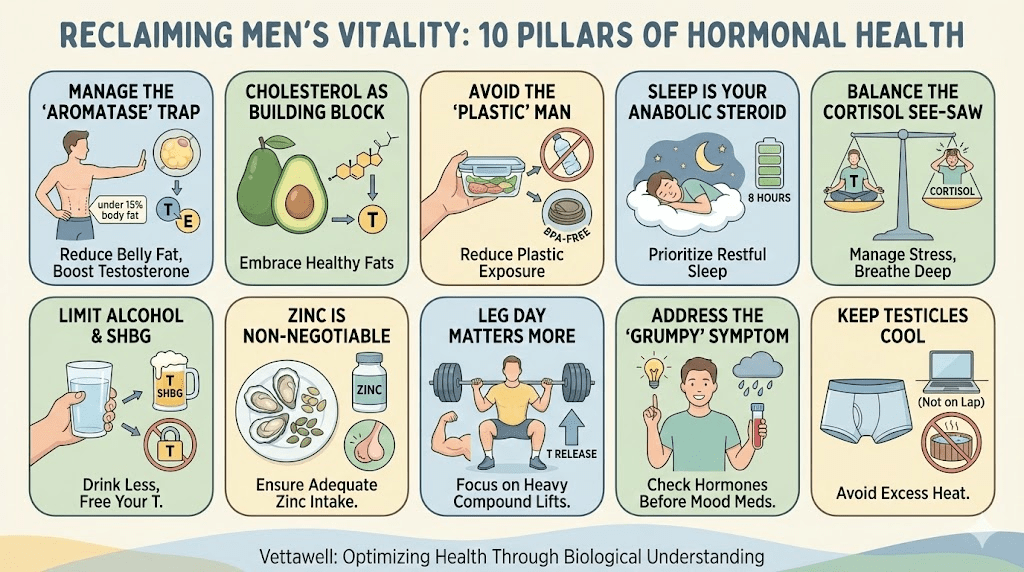
- Testosterone physiology — how testosterone actually works across the lifespan, what drives decline, what the evidence says about optimization, and how to distinguish clinical hypogonadism from lifestyle-driven suppression.
- Strength training programming — evidence-based resistance training for health, longevity, and performance, with particular attention to the compound movements and progressive loading that produce durable results.
- Cardiovascular health — the male-specific risk patterns, the markers that matter most, and why men consistently present later and worse than they should for conditions that were often detectable years earlier.
- Male pattern hair loss — the biology of androgenetic alopecia, the evidence base for available interventions, and how to navigate a market full of products that exploit insecurity rather than address mechanisms.
- Prostate and sexual health — topics that remain under-discussed in men's media despite their outsized impact on quality of life and long-term health outcomes.
- Male-specific hormonal and metabolic patterns — how male physiology differs from female physiology in ways that matter clinically, and how mainstream health guidance often fails to account for those differences.
The Advocacy Work
Marcus is a vocal and consistent advocate for men engaging with preventive care — routine bloodwork, skin checks, cardiovascular screening, mental health support. Not as a lifestyle brand or a wellness aesthetic, but as a straightforward claim: the men who live longest and best are the ones who treat their health as information to act on, not a problem to ignore until it becomes a crisis.
"The cultural script that tells men silence is strength is not neutral. It has a body count. I write to offer something different — not a replacement script, but an actual conversation."
He writes regularly about dismantling the specific cultural narratives that keep men from seeking help: the conflation of stoicism with avoidance, the shame attached to vulnerability, the performance of invulnerability that costs men years of life and quality of life they never recover.
Outside the Work
Marcus trains five days a week and competes occasionally in powerlifting — an environment he finds refreshingly honest about the relationship between effort, recovery, and result. He is based in Chicago, where he writes, trains, and remains convinced that most men's health problems are both more preventable and more treatable than the culture around them suggests.