Confessions of a Failed "Morning Person": How Embracing My "Wolf" Chronotype Saved My Career
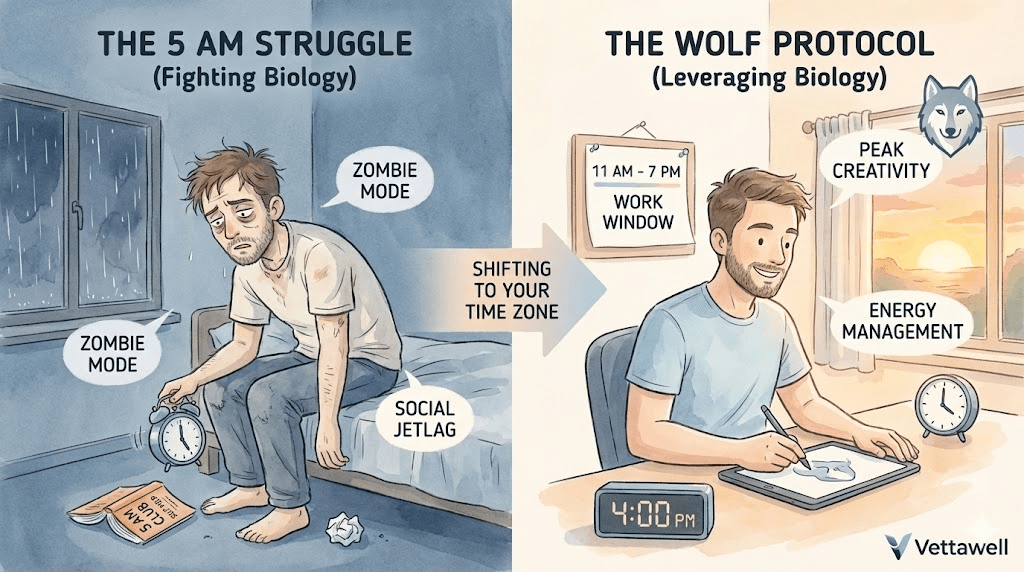
For the first decade of my career as a graphic designer, I lived in a state of perpetual shame. I read the books. I listened to the podcasts. They all preached the same gospel: successful people wake up before the sun. So I tried to become one of them.
I set three alarms. I bought a sunrise lamp. I left my phone in the kitchen. I even tried the “cold shower = discipline” routine. And every single morning I woke up feeling like I’d been hit by a truck. By mid-afternoon I was foggy and irritable, staring at my screen like it was written in another language.
I wasn’t failing at motivation. I was failing at biology.
Key takeaways
- Chronotype is your built-in timing preference—when your brain naturally wants to wake, focus, and sleep.
- “Social jetlag” happens when your schedule consistently fights your internal clock (even if you sleep “enough”).
- The goal isn’t to become a morning person; it’s to create reliable sleep and reliable performance.
- Small changes—meeting timing, light exposure, caffeine cut-offs, and deep-work scheduling—can produce outsized results.
- You can respect your chronotype while still functioning in a 9–5 world by designing smarter boundaries and rituals.
My name is Liam, and I am a recovering member of the "5 AM Club"
Here’s what no one tells you about “early rising” advice: it works beautifully for some people—and punishes others. I’m not against mornings. I’m against pretending all bodies run the same software.
In my worst year, I was waking at 5:30 AM and sleeping around midnight, convinced that pain was proof of progress. But what I got wasn’t progress—it was a slow cognitive erosion: less creativity, more mistakes, and a growing dread of anything important scheduled before noon.
The breaking point
The low point came during a client presentation. I’d forced myself up early to “seize the day.” At 11:00 AM—when I was supposed to be sharp—I felt my attention flicker. I didn’t fully fall asleep, but I did something worse: I zoned out mid-sentence and lost my thread. The client didn’t notice. My body did.
I booked an appointment with a sleep specialist expecting to be told I had insomnia, sleep apnea, or some personal weakness I could fix through grit. Instead, she asked about my natural sleep patterns—when I felt most alert, when I got my best ideas, when I wanted to eat, when my mood dipped.
“You don’t sound broken,” she said. “You sound misaligned.”
The biology of time
She explained that humans vary in their circadian timing. Some of us are naturally earlier, some later, and most are in the middle. This timing preference is influenced by biology (including genetics), age, and environment. The important part: your internal clock doesn’t negotiate because you read a productivity book.
Chronotypes, explained without the hype
One popular way to describe chronotypes uses animal labels—helpful as shorthand, not as destiny. In that framework:
- Lions: naturally early risers with strong morning energy.
- Bears: the majority—best aligned with a “sun-following” schedule.
- Wolves: later chronotypes (night-leaning) with stronger late-day focus.
- Dolphins: lighter, more fragmented sleepers who struggle with consistency.
I was a textbook Wolf. My evenings were productive. My mornings were a fog. I could “power through,” but at a cost: my creative output flattened and my mood became more volatile.
What “social jetlag” feels like
Social jetlag isn’t a vibe—it’s a pattern: your internal clock wants one schedule, but your life demands another. The result can look like laziness or poor discipline, but it behaves more like a mild, chronic form of time-zone travel.
- You wake up feeling unrefreshed even after 7–8 hours.
- Your best thinking happens late in the day, when everyone else is winding down.
- You rely on caffeine to act “normal” in the morning.
- Weekends become recovery missions, not rest.
The trap: trying to force peak creativity at the wrong time
Design work is not assembly-line labor. It requires attention, pattern recognition, emotional tone, and the ability to hold a messy idea long enough to shape it. When I tried to do that at 8:00 AM, I wasn’t building discipline—I was scheduling my most cognitively expensive work during my lowest cognitive window.
Time management didn’t fix me. Energy timing did.
The "Wolf" protocol: how I redesigned my workday
I didn’t quit my job or move to a different time zone. I proposed a one-month experiment to my boss: shift my hours from 9–5 to 11–7, and measure output. To my surprise, he agreed—partly because the team needed better late-day coverage.
My new rules (simple, strict, and realistic)
- No deep work before 11:00 AM. Mornings were for low-stakes tasks: email triage, file organization, admin, light planning.
- Schedule creative blocks after 3:00 PM. I placed design sprints in the late afternoon when my brain reliably “came online.”
- Protect the handoff. I used a 15-minute daily briefing note so the team could move forward without morning meetings.
- Keep sleep consistent. I stopped chasing a “perfect bedtime” and focused on a reliable wake time and enough total sleep.
- Caffeine had a cutoff. No caffeine late enough to sabotage my actual sleep window.
The 4:00 PM peak (my secret advantage)
Most offices treat late afternoon like the productivity graveyard. For me, it was the opposite. By 4:00 PM my brain was warm, coherent, and creative. The office was quieter, interruptions dropped, and my focus expanded. That became my competitive edge.
What I changed outside of work
- Morning light anyway: I still got outside within an hour of waking to strengthen circadian cues—without forcing myself to wake earlier than my biology could sustain.
- Evening wind-down: I built a buffer between work and bed so my brain stopped treating 1:00 AM like “meeting time.”
- Food timing: I stopped skipping breakfast out of shame and instead ate a light, protein-forward meal when I woke to stabilize energy.
- Screens with boundaries: Not “no screens ever,” but no doom-scrolling in bed.
The results (what changed in 30 days)
The difference was not subtle. My output didn’t just stabilize—it improved. I finished projects faster, delivered cleaner drafts, and had fewer late-night panic edits. Most importantly, my work felt like mine again. The creativity returned.
- Fewer errors in client decks and file exports.
- More consistent mood and energy across the week.
- Shorter work hours with higher-quality output.
- Less reliance on caffeine to function.
- Better sleep because I stopped fighting bedtime with guilt.
The “5 AM Club” is great advice—if you’re a Lion. For the rest of us, performance is about alignment.
If you can’t change your hours, do this instead
Not everyone can shift their schedule. But you can still reduce social jetlag by moving the type of work—not just the amount of work—into the right windows.
A practical re-map
- Morning: admin, planning, review, routine tasks, low-creative output.
- Midday: meetings that require verbal clarity, collaboration, decision-making.
- Late day: deeper focus work, writing, design, problem-solving (if you’re a Wolf).
- Evening: wind-down buffer; protect sleep more than your to-do list.
Common pitfalls
- Using “night owl” as permission for chaos instead of building consistency.
- Sleeping in on weekends to recover, then feeling awful Monday (social jetlag whiplash).
- Over-caffeinating late in the day and sabotaging the sleep you need to function.
- Scheduling your highest-stakes cognitive work during your lowest-energy window.
- Assuming you’re broken when you’re actually just misaligned.
Practical next steps
- Track your real energy for 7 days: when do you feel mentally sharp, social, creative, and tired?
- Identify your chronotype leaning (early, middle, late) and stop forcing a schedule that reliably fails.
- Pick one anchor: consistent wake time (±30–60 minutes) for 14 days.
- Move one high-cognitive block into your best window and protect it with calendar boundaries.
- Set a caffeine cut-off that protects your sleep window (start with 8 hours before bed).
- Use morning light and a wind-down routine to stabilize your rhythm without self-punishment.
Quick checklist
- Wake time is consistent most days.
- Deep work is scheduled when energy is naturally highest.
- Morning tasks match morning capacity (low-stakes, low-creative).
- Caffeine supports performance without stealing sleep.
- Evenings include a buffer so sleep isn’t “accidental.”
Important note: This article is educational and not medical advice. If you have persistent sleep issues, severe daytime sleepiness, or concerns about sleep disorders, consult a qualified healthcare professional.