
Most hair advice treats heat as the villain and air as the hero: put down the blow dryer, let it air dry, avoid "damage". That logic feels obvious—until you look at hair under a microscope. Hair is strongest when it’s dry and compact. It becomes softer, stretchier, and far more fragile when it’s swollen with water. In other words, the biggest risk isn’t always the dryer—it’s the hours your hair spends wet.
Heat can scorch the surface. But water can quietly weaken the structure from the inside.
The counterintuitive truth: water changes hair chemistry
A hair strand is a protein fiber (mostly keratin) held together by multiple bond types. When your hair gets wet, hydrogen bonds break and reform, which is why wet hair is easier to reshape—but also why it can feel floppy and elastic. The longer the hair stays in that softened state, the longer it stays vulnerable to friction, tension, and mechanical stress (brushing, twisting, sleeping on it, tying it up).
The sponge effect
Hair isn’t a smooth plastic tube. It’s layered architecture designed to protect a softer core. When the core absorbs water, it expands—sometimes significantly—like a sponge. That expansion pries the outer layer open.
- Cuticle: overlapping scales that act like roof shingles—protection and shine.
- Cortex: the inner structure that gives strength, elasticity, and color pigments.
- Cell Membrane Complex (CMC): the lipid-and-protein “mortar” that holds layers together and keeps water movement controlled.
When the cortex swells, cuticle scales lift. That lift increases surface roughness and friction—so simple actions like rubbing with a towel or pulling on a ponytail can cause micro-chips along the cuticle edge.
Porosity is basically how easily your hair takes in water and how easily it lets it go. High-porosity hair (often bleached, colored, or naturally curly/coily) drinks water fast—and can stay swollen for longer. Low-porosity hair may resist water at first but still suffers if it stays wet for hours.
- Signs of higher porosity: hair dries quickly but feels rough, tangles easily, and breaks when brushed wet.
- Signs of prolonged wet time risk: hair takes 3+ hours to fully dry, feels gummy when wet, or stretches noticeably before snapping.
Hygral fatigue: the damage that comes from swelling and shrinking
The term hygral fatigue describes what happens when hair repeatedly expands (wet) and contracts (dry). Over time, that cycling can weaken the CMC and increase internal stress in the fiber. The result is hair that loses elasticity, frays at the ends, and snaps more easily—even if you “never use heat.”
- Long wet time: air-drying thick hair for 4–6 hours keeps hair in its most fragile state.
- Frequent soaking: daily full saturations without protective conditioning.
- Hot water + harsh surfactants: can strip protective lipids, increasing swelling.
- Bleach and heavy coloring: can raise porosity and reduce structural resilience.
- Wet detangling with tension: brushing aggressively while hair is stretched.
If your hair lives wet, it lives vulnerable.
Air-dry vs blow-dry: what the research suggests
The heat conversation is usually framed as binary—dryer = damage, air = safe. Realistically, both extremes can be harmful. High heat can roughen the cuticle and cause surface cracking. But prolonged water exposure can stress internal structures. Some dermatology research comparing air-drying to controlled blow-drying suggests a useful takeaway: moderate, moving airflow at a safe distance may reduce overall damage by shortening wet time.
- High heat risk: surface cuticle wear, brittle ends, loss of shine.
- Prolonged wet risk: internal fatigue + more friction damage during the swollen phase.
- The middle path: remove water faster without cooking the cuticle.
The wet-hair danger zone
Wet hair is mechanically weaker. It stretches more, and stretching increases the chance of breakage—especially at the mid-lengths and ends. Add friction (towels, cotton pillowcases, hoodies) and you get a perfect recipe for split ends.
If you go to bed with wet hair, you combine maximum fragility with hours of friction and compression. The hair can dry in distorted shapes, the cuticle rubs against fabric, and tangles “set” overnight. If this happens occasionally, it’s not a moral failure—but as a habit, it’s a predictable damage pattern.
A damp scalp for long periods can create a warm, humid environment where irritation is more likely—especially if you already deal with itch, flakes, or sensitivity. This doesn’t mean wet hair automatically causes problems, but if your scalp is reactive, reducing prolonged dampness is one simple lever you control.
The optimal drying protocol
Think of drying as two phases: water offload (get hair out of the swollen state quickly) and gentle finish (keep cuticle wear low). The goal is not “no heat.” The goal is less time wet + less time hot.
- Pre-shower detangle (if needed): remove knots gently before water makes them tighter; use a wide-tooth comb on dry or lightly damp hair.
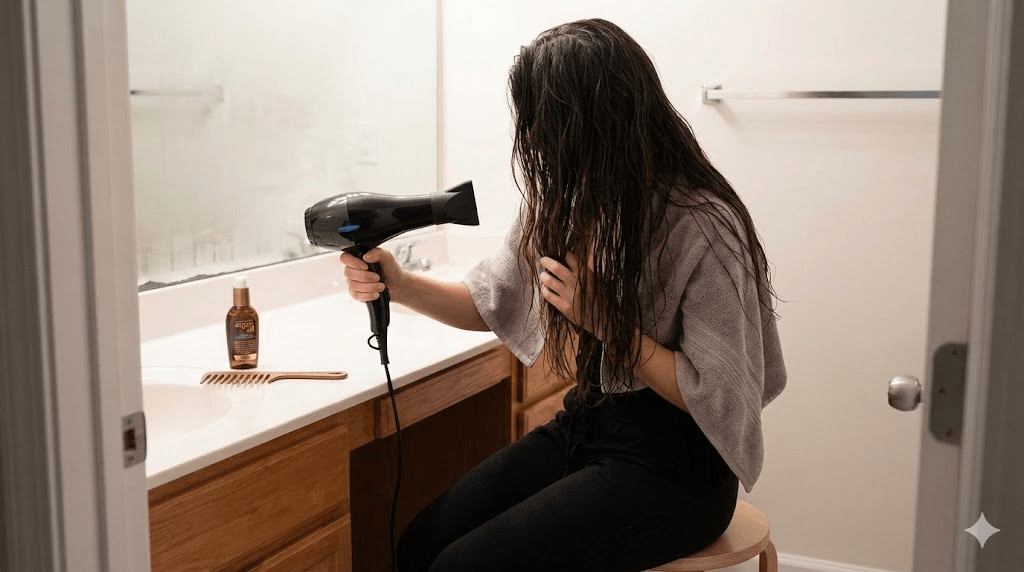
- Blot, don’t rub: use a microfiber towel or soft T-shirt to squeeze out water until hair is no longer dripping.
- Apply protection on damp hair: a leave-in conditioner for slip + a heat protectant if you will use airflow. Less friction now equals fewer splits later.
- Rough-dry on low/cool: keep the dryer moving; aim for 70–80% dry quickly rather than perfectly styled immediately.
- Finish strategically: if styling, use the lowest effective heat; if not styling, stop once hair is mostly dry and let the last 10–20% air-finish.
- Distance: keep airflow at least ~15 cm (6 inches) away when using a dryer.
- Movement: never park the nozzle in one spot; think “paintbrush,” not “laser.”
- Tension: avoid tight elastics on damp hair; use a soft scrunchie if you must tie it back.
- Timing: the longer your hair stays wet, the more valuable gentle airflow becomes.
If you insist on air-drying, make it shorter (not harder)
Air-drying can still work, especially if you have fine hair or live in a dry climate. The trick is to reduce wet time and reduce friction while it dries.
- Remove water aggressively but gently: blot with microfiber until hair is just damp.
- Use slip: a light leave-in reduces tangling while hair sets.
- Protect during dry-down: avoid hoodies, scarves, and rough collars until hair is mostly dry.
- Don’t twist into tight buns: damp buns = tension + distortion + breakage.
Product choices by function (not hype)
You don’t need a 12-step routine. You need the right roles covered—especially if your hair is color-treated, curly, or breakage-prone.
- Slip + conditioning: a lightweight leave-in for detangling and reduced friction.
- Heat protection: if using airflow, choose a protectant that doesn’t leave heavy residue.
- Oil as a seal (optional): a few drops on damp ends can reduce roughness and slow rapid water movement in very porous hair.
- Clarifying (occasionally): buildup can make hair feel dull and harder to dry evenly—use sparingly, then condition.
Practical next steps
- For the next 14 days, time your wet-to-dry window. If it’s consistently 3+ hours, experiment with gentle low/cool airflow to cut it in half.
- Replace rubbing with microfiber blotting immediately after washing.
- Stop sleeping on damp hair for one month and note changes in breakage, tangles, and scalp comfort.
Quick checklist
- Hair is not left dripping wet for long periods.
- Towel friction is minimized (blotting > rubbing).
- Airflow is low/cool, moving, and kept at a safe distance.
- Detangling happens with slip and low tension.
- Scalp feels calm most days (less itch, less flare).