
The 2025 Hair Forecast: Exosomes, “Rewilding,” and the Rise of Neuro‑Cosmetics
As we move deeper into 2025, the line between skincare, healthcare, and hair care keeps blurring. Hair routines are no longer only about making the strand look glossy for a few hours—they’re increasingly about influencing the living tissue underneath: the scalp barrier, follicle signaling, and the stress pathways that decide whether a follicle stays in growth mode or quietly checks out.
This guide breaks down The 2025 Hair Forecast: Exosomes, “Rewilding,” and the Rise of Neuro‑Cosmetics into the mechanisms that are actually driving the trend cycle—and the practical decisions that matter if you’re trying to protect density, reduce shedding, or simply avoid wasting money on hype.
In 2025, the “best” hair product is often a system: scalp barrier + cellular signaling + nervous‑system regulation.
What’s different about hair care in 2025
Two big shifts are happening at once. First, the industry has finally admitted a hard truth: you can’t “repair” a dead hair fiber the same way you can heal skin. Most of what we call repair is surface engineering—smoothing, coating, and reducing breakage. Second, the science conversation has moved upstream to the follicle environment: inflammation, circulation, microbiome balance, and the molecular messages that tell follicles to stay active.
That’s why 2025 is full of treatments that sound like biotech (exosomes), ecology (rewilding), and neuroscience (neuro‑cosmetics). The opportunity is real—some of these directions are promising. The risk is also real: the marketing language often runs far ahead of clinical evidence.
Key takeaways
- Exosomes are positioned as a cell‑messaging approach: not “more growth,” but “better signals” to follicles—yet quality control and clinical evidence vary widely.
- Scalp “rewilding” reframes a healthy scalp as an ecosystem, not a sterile surface—barrier repair and microbiome support are becoming the new baseline.
- Neuro‑cosmetics treat hair loss risk as partly a stress‑biology problem: down‑regulating arousal through scalp rituals (massage, scent, sensory inputs) can be supportive—especially for stress‑linked shedding.
- The winning 2025 routine is layered: reduce inflammation + protect barrier + stabilize the nervous system + choose one evidence‑based regrowth lever (medical or procedural) if needed.
Trend 1: The buzzword of 2025—Exosomes
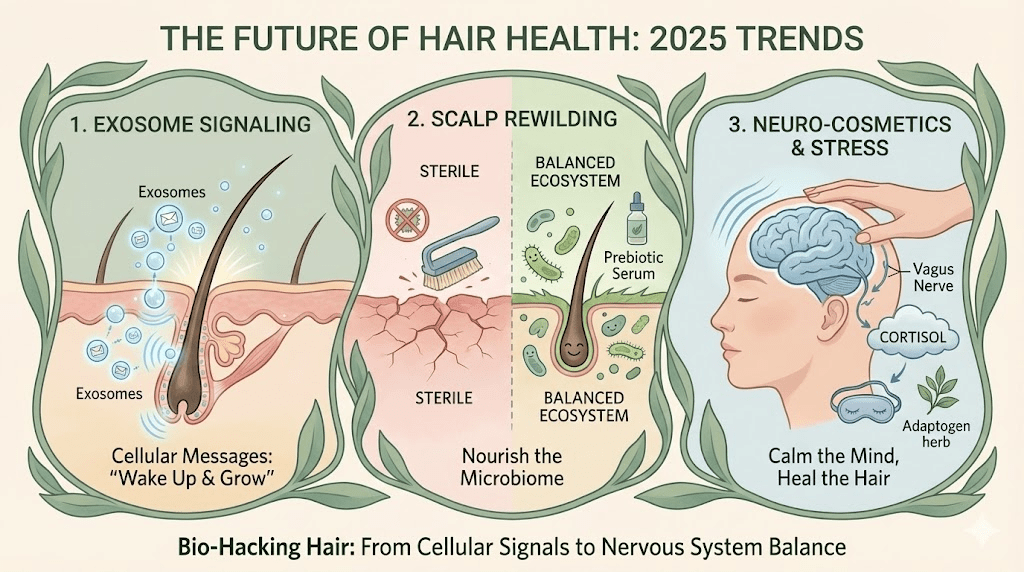
If 2020 was the era of bond builders and 2023–2024 popularized botanical growth hacks, 2025 is the year exosomes entered mainstream beauty language. The simplest way to understand the exosome story is this: scientists realized that many regenerative effects attributed to stem cells may be driven by the signals those cells release—not the cells themselves.
Exosomes are tiny extracellular vesicles—microscopic “envelopes” that can carry proteins, lipids, and nucleic acids. In biology, they function like a delivery system for instructions: repair, calm inflammation, remodel tissue, change behavior. In hair marketing, that becomes: wake follicles up.
- Delivery method: Often paired with microneedling, microchanneling, or in‑clinic infusion so the product can reach the scalp surface and upper follicle environment more effectively.
- Positioning: Described as “follicle reprogramming” or “cellular communication support,” rather than a blood‑flow stimulant like minoxidil.
- Experience: Many clinics frame it as a “scalp facial”—cleansing + barrier prep + delivery + calming serum + LED or massage.
Exosomes are a real biological concept, but the commercial landscape is uneven. “Exosome” can mean different things depending on sourcing, purification, storage, and testing. In practice, this means outcomes can vary dramatically between providers—even when the marketing sounds identical.
- Quality control is the bottleneck: Ask how the product is sourced, stored, and tested (sterility, particle characterization, and batch consistency).
- Evidence is still maturing: Some early clinical and observational data is encouraging, but it’s not a universal, guaranteed regrowth solution.
- Expectations matter: Exosomes may be most plausible as a supportive intervention—improving scalp environment, inflammation, and signaling—rather than replacing proven therapies for androgenetic alopecia.
- Potential fit: People with early thinning, post‑stress shedding recovery, postpartum shedding recovery, or scalp inflammation patterns—especially if paired with a broader plan.
- Pause and get medical guidance: Anyone with active scalp infection, uncontrolled inflammatory scalp conditions, or who is immunocompromised. Also pause if a provider promises guaranteed regrowth in weeks.
Trend 2: Scalp “Rewilding” and the end of “squeaky clean”
For decades, many routines treated the scalp like a floor that needed aggressive degreasing: strip oils, scrub flakes, sterilize. In 2025, microbiome and barrier science continues to push a different model: your scalp is a living environment that needs stability more than aggression.
“Rewilding” is the consumer-friendly label for a serious idea: supporting the scalp’s protective ecosystem so it can defend itself, regulate oil production, and reduce low‑grade inflammation that can worsen shedding.
Many people with oily roots are actually dealing with a compromised barrier. When you over‑strip, the scalp can respond by producing more oil as compensation, while the skin underneath feels tight, itchy, or reactive. That inflammatory loop can increase shedding and make styling harder.
- Gentler cleansing: Less harsh surfactants, fewer aggressive scrubs, and a focus on scalp comfort after washing.
- Barrier support: Humectants and soothing actives (think hydration + calming) rather than constant exfoliation.
- Prebiotics/postbiotics positioning: Products that aim to support a balanced microbiome rather than “kill everything.”
- Fewer dramatic resets: Consistency beats constant switching; the scalp often needs weeks to calm down.
In 2025, the smartest “growth” move often starts with irritation reduction. A scalp that stings, itches, or flakes aggressively is a scalp spending resources on defense—not growth. Calming the environment can reduce shedding triggers and improve the performance of any active treatment you add later.
Trend 3: Neuro‑cosmetics and psychodermatology for hair
The most interesting 2025 pivot is the admission that hair is not purely cosmetic—it is neuro‑endocrine. Stress biology can push follicles prematurely into rest (telogen) and increase shedding, particularly after a big stressor, illness, or prolonged sleep disruption.
Neuro‑cosmetics is the beauty industry’s attempt to package nervous‑system support into topical and ritual form: sensory cues, scalp massage, and formulations that are marketed as “calming.” Even when the topical effect is modest, the ritual effect can be meaningful—because it changes the physiology that drives the behavior loop (scratching, picking, over‑washing, over‑treating).
- Down‑shift arousal: Fragrances and sensory textures designed to signal safety and reduce “wired” tension during application.
- Support stress‑linked shedding contexts: Not as a stand‑alone cure, but as part of a plan when sleep, anxiety, or overload are present.
- Turn application into therapy: Scalp massage becomes a nervous‑system tool, not just a growth tactic.
- Use a gentle cleanser and avoid “squeaky” finish; aim for clean and comfortable.
- Apply a light scalp serum and do a 2–3 minute massage: slow, steady pressure, not aggressive scratching.
- Pair the ritual with a 60‑second downshift: one or two physiological sighs (double inhale + long exhale) to reduce arousal.
- Keep the routine consistent for 4–8 weeks before changing products, unless you’re reacting.
How to evaluate 2025 hair trends without getting played
If you want a simple filter, ask: Is this targeting fiber, scalp environment, or follicle signaling? Fiber products can make hair look better immediately but won’t change growth. Scalp environment changes take weeks. Follicle signaling interventions—medical or procedural—take months to show meaningful differences.
- What is the exact protocol (delivery method, frequency, total sessions)?
- What outcomes are realistic by 3 months vs. 6 months?
- What are the contraindications and common side effects?
- How is the product stored and validated (batch tracking, sterility, stability)?
- What is the plan if there is no response—what’s the next step?
- Promises of “guaranteed regrowth” or “permanent” results in weeks.
- A single solution pitched as replacing sleep, nutrition, and medical evaluation.
- No discussion of shedding types (stress shedding vs. pattern thinning) and timelines.
- No plan for maintenance—most true hair improvements require ongoing support.
The Bottom Line
In 2025, the most effective hair approach is less about chasing a miracle bottle and more about building a layered system. Think: calm the scalp, protect the barrier, support the microbiome, and regulate stress biology—then add one targeted growth lever if your shedding pattern calls for it.
Exosomes may become a meaningful part of that system for some people, but the biggest “quiet” advantage is still foundational: adequate sleep, consistent nutrition, and a scalp routine that stops triggering inflammation.
Practical next steps
- Run a 14–21 day scalp calm-down phase: gentle cleansing, minimal actives, avoid harsh scrubs and heavy fragrance if you’re reactive.
- Choose one primary lever and commit for 8–12 weeks: medical guidance, a procedural plan, or a simplified barrier-first routine.
- Reduce friction and wet-time: microfiber blot, detangle gently, avoid sleeping with wet hair when possible.
- Track the right metric: shedding count and scalp comfort weekly; density changes monthly (photos in the same lighting).
Quick checklist
- Scalp feels calm after washing (no sting, burn, or tightness).
- Routine has been consistent for at least 6–8 weeks.
- Heat and friction are managed (drying strategy, pillowcase, detangling).
- Stress and sleep are addressed as part of the plan (not an afterthought).