The Quantum Wave Reset: The 7‑Minute Brainwave Ritual Behind 2026’s "Signal Economy" (and What Science Actually Says)
2026 is the year the wellness world stopped pretending the mind is "just mindset." People are burned out, overstimulated, and running on notifications. The new obsession isn’t motivation—it’s signal. Can you hear your own thoughts without the constant interference of stress, scrolling, and decision fatigue?
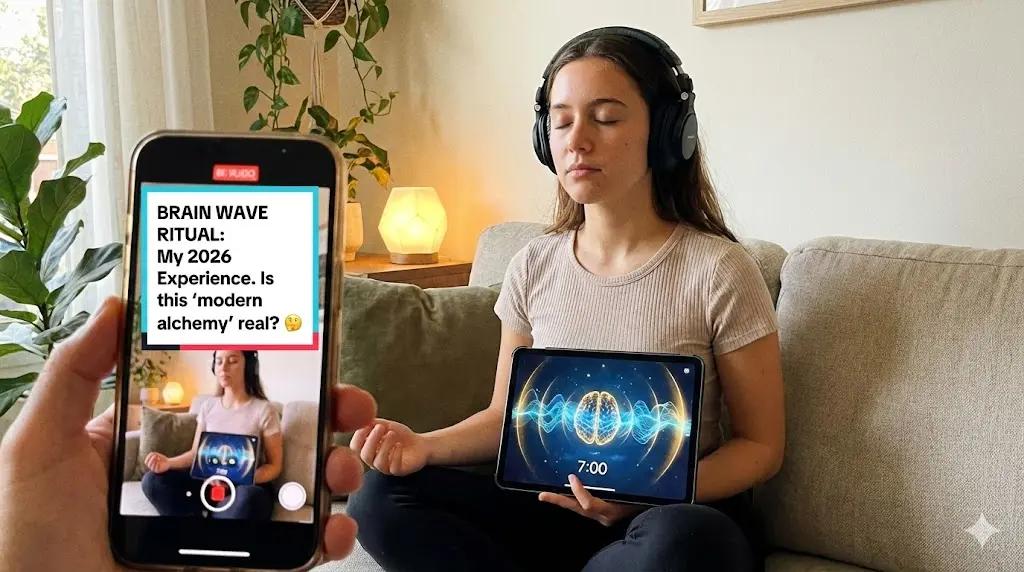
That’s why "brainwave" programs are surging. They promise a shortcut: put headphones on, press play, and let your nervous system downshift. One of the loudest entries in this trend is Quantum Wave—a 7‑minute audio track positioned as a daily practice for relaxation, mental clarity, and personal development.
In 2026, the question isn’t “How hard can you grind?” It’s “How clean is your signal when you make decisions?”
But the internet is also full of overhyped claims. Some pages around “quantum” audio talk about “God Mode,” instant luck, and physics‑level reality bending. So let’s do something rare: keep the vibe, keep the curiosity—and add a reality check. This article will unpack what Quantum Wave is offering, what parts are plausible, what parts are metaphor, and how to use it in a grounded way that actually helps.
Key takeaways
- Brainwave entrainment is a real phenomenon: rhythmic audio can influence brainwave activity for some people, often experienced as relaxation or focus.
- “Quantum” language is frequently used in wellness as a metaphor for nonlinear change—but quantum physics in labs is not the same thing as predicting markets or attracting money.
- Microtubules and Orch‑OR (a quantum consciousness theory) are fascinating and controversial. They are not universally accepted proof that a 7‑minute track can “activate antennas.”
- The safest, most useful frame: treat Quantum Wave as a daily nervous‑system reset that supports better choices—not as guaranteed transformation.
- Results vary widely. The best outcomes usually come from combining the audio with basics: sleep, hydration, movement, and reduced dopamine overload.
What Quantum Wave claims to be (and what it explicitly is not)
First, the cleanest starting point: the Quantum Wave website describes the program as an educational audio tool for personal development—not a medical treatment and not a guaranteed solution. That matters. It’s the difference between a practice you experiment with and a promise you gamble on.
In practical terms, Quantum Wave positions itself as a short daily listening session designed to guide the brain into certain brainwave states associated with calm and clarity. The core offer is a 7‑minute brainwave entrainment track, plus supporting materials (a tracking journal, a grounding track, and a quick‑start guide).
A grounded way to interpret the offer
- Best-case: you feel calmer, less reactive, and more mentally organized after consistent use.
- Typical-case: you notice subtle benefits—sleep onset feels easier, rumination reduces, you handle stress with slightly more space.
- No-change case: you don’t feel much, or you dislike the audio experience. That’s normal in this category of tools.
A wellness audio track isn’t a miracle. But it can be a lever—if it helps you regulate long enough to make different choices.
Why “quantum” is everywhere in self‑help (and what it actually means in physics)
Let’s decode the word that creates most of the confusion: quantum. In physics, quantum mechanics describes how matter and energy behave at tiny scales. It includes real phenomena like superposition and entanglement—effects tested in laboratories with extremely controlled conditions.
In wellness marketing, “quantum” is often used as a symbol for rapid, nonlinear change: the idea that you can shift your life quickly when the right internal conditions align. That metaphor can be motivating. The danger is when the metaphor is sold as literal proof.
What quantum entanglement is (in plain language)
- Entanglement describes correlations between particles that can be measured even when they are far apart.
- It does not mean information is freely transmitted faster than light in the everyday sense.
- It does not automatically imply humans can “teleport” intuition or manifest money via physics.
So if you see copy claiming a straight line from quantum entanglement to guaranteed personal wealth, treat that as storytelling—not established science. The more honest bridge is psychological: when you’re calmer and less scattered, you see patterns, take better actions, and stop sabotaging yourself. That can look like “luck” from the outside.
The microtubule idea: fascinating frontier or marketing shortcut?
Quantum Wave—like many modern audio programs—references microtubules, tiny structural components inside cells (including neurons). Some researchers have explored whether microtubules could play a role in consciousness, including the controversial Orch‑OR theory associated with physicist Roger Penrose and anesthesiologist Stuart Hameroff.
Here’s the responsible way to hold this: microtubules are real and important. The question of whether quantum effects in microtubules are central to consciousness is still debated. Even if future research strengthens the theory, it would not automatically validate every claim made in marketing.
A balanced “yes-and” summary
- Yes: microtubules have measurable physical properties and are a legitimate subject of research.
- Yes: some scientists have proposed models linking microtubules to cognition and anesthesia.
- And: none of that proves that a specific consumer audio track can reliably “activate” quantum antennas or cause reality to reorganize on command.
Curiosity is powerful. But credibility matters. Use frontier science as inspiration—not as proof.
Brainwave entrainment 101: what a 7‑minute track can realistically do
Brainwave entrainment is the idea that rhythmic stimuli (like pulsing sounds) can nudge brain activity toward certain frequency bands. People often talk about alpha (relaxed alertness) and theta (drowsy, inward, creative states).
The most practical takeaway is simple: audio can become a cue for state change. If you listen in a consistent context—quiet room, eyes closed, same time each day—your brain learns: “This is the downshift.” That conditioning effect can be as important as the frequencies themselves.
What users often experience when it works
- A drop in physical tension (jaw, shoulders, belly).
- Less mental chatter for a short window.
- A more “spacious” feeling—like you have a half‑second more time before reacting.
- Easier transition into sleep if you listen in the evening.
- More creativity when you listen before writing, planning, or problem-solving.
What it usually does not do on its own: replace therapy, treat depression, cure anxiety disorders, or guarantee money outcomes. The safest frame is to treat it as a tool for regulation and clarity—which indirectly supports better life outcomes.
The 7‑minute protocol: how to use Quantum Wave like a serious practice
If you want to evaluate any audio program fairly, you need a repeatable protocol. Otherwise you’re just sampling vibes. Here’s a structured way to test a 7‑minute track without turning it into a religion.
Setup rules (small details, big difference)
- Headphones matter: the stereo effect is part of most entrainment designs.
- Eyes closed: reduces sensory noise and makes state shifts easier.
- Same window daily: consistency builds a conditioned response faster than randomness.
- No multitasking: don’t combine with email, driving, or scrolling.
A 21‑day experiment (simple and measurable)
- Pick a consistent time (morning reset or pre-sleep).
- Before you press play, rate your state 1–10: stress, clarity, and body tension.
- Listen for 7 minutes with eyes closed and relaxed breathing.
- Afterward, rate the same metrics again.
- Write one sentence: “What changed?” (even if the answer is “nothing”).
- Repeat for 21 days and look for trends—not dramatic day‑one fireworks.
The point isn’t to “feel something.” The point is to build a repeatable off‑ramp from mental static.
“Quantum luck” explained without magic
Many people who love these programs describe a strange side effect: more synchronicities, better timing, “coincidences,” and opportunities. You can interpret that spiritually if you like. But you can also explain a large part of it with psychology and behavior.
Three non-mystical mechanisms that look like “luck”
- Attentional filter shift: when you’re calmer, you notice more (and you miss fewer signals).
- Impulse control improves: fewer reactive choices means fewer self‑created fires.
- Follow‑through rises: clarity makes you do the boring steps that create outcomes.
In other words: when your nervous system isn’t screaming, you’re more likely to take the call, send the message, have the hard conversation, or spot the obvious solution. That’s not supernatural—it’s regulated cognition.
What “reviews” tend to sound like (without pretending we know your results)
If you read enough feedback on brainwave-audio tools, you’ll notice patterns. Not everyone experiences them the same way, and that’s normal.
The three common camps
- Immediate downshifters: feel calm in the first week; love it as a nightly ritual.
- Slow accumulators: nothing dramatic at first, then notice better sleep and steadier mood after 2–4 weeks.
- Non-responders: dislike the sound, get irritated, or feel no meaningful change.
A fair mindset is to treat this like trying a new training style. Some bodies respond to yoga immediately. Some need time. Some prefer running. You’re not broken if this isn’t your tool.
Common mistakes that kill the effect
- Listening while scrolling (your brain stays in high-input mode).
- Using it only when you’re in crisis (too inconsistent to build the conditioned response).
- Turning the volume up aggressively (irritation reduces relaxation).
- Expecting money miracles, then feeling disappointed and quitting early.
- Ignoring basics: sleep debt, dehydration, and constant caffeine can overpower subtle tools.
A 7‑minute track can’t out-compete 14 hours of overstimulation. But it can be the start of a new pattern.
Who should be cautious
Any brainwave audio product should be used with basic safety. If you’re prone to seizures, have a history of photosensitive epilepsy, or experience strong dissociation, consult a qualified clinician before using entrainment tools. If a track makes you feel dizzy, panicky, or “off,” stop and reassess.
And as with any personal-development product: if you have depression, anxiety, trauma symptoms, or a medical condition, treat audio tools as adjacent support, not replacement care.
A decision framework: is Quantum Wave worth trying?
Instead of asking “Is it real?” ask: “Is this a reasonable experiment for my goals?” Here’s a simple decision matrix.
- Try it if: you want a short daily relaxation practice, you like audio rituals, and you can commit to a 21‑day experiment without expecting miracles.
- Skip it if: you’re looking for guaranteed financial outcomes, you hate headphones, or you expect one track to fix complex mental-health issues.
- Try a different tool if: your main problem is sleep schedule, nutrition, or untreated anxiety—address the root first, then add audio support.
Bottom line
Quantum Wave sits inside a real 2026 trend: the shift from “think your way out” to regulate your way out. The strongest version of this offer is not “God Mode” hype. It’s a practical promise: give your brain a consistent 7‑minute downshift, and your days may feel less chaotic.
If you approach it like a ritual—quiet room, headphones, consistency—you may get exactly what modern life steals: a clearer signal, a calmer body, and decisions that feel less frantic. And if you don’t? That’s information too. The goal isn’t belief. The goal is results you can observe.
Important note: This article is educational and not medical advice. Results vary widely. If you have concerns about your mental health or physical health, consult a licensed professional. Use any audio program responsibly—never while driving, operating machinery, or doing tasks requiring full attention.