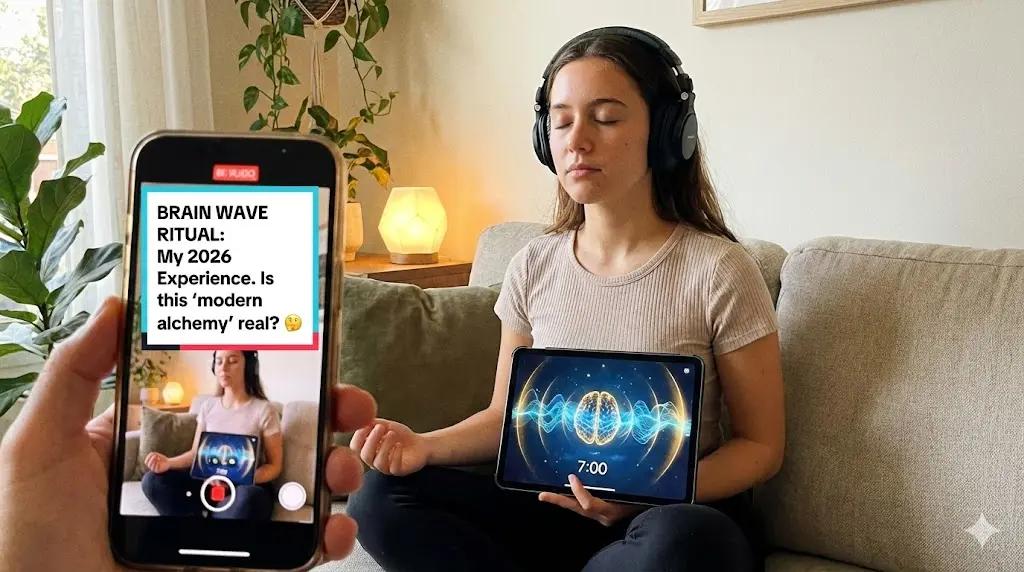
Serena Voss began her academic life studying clinical psychology — then did something her professors considered unusual: she spent her postgraduate years at the intersection of evidence-based cognitive therapy and contemplative traditions from Eastern philosophy. That combination, which seemed eccentric at the time, turned out to be precisely the place where the most interesting questions about mind, belief, and wellbeing actually live.
The Formative Years
After completing postgraduate training in Mindfulness-Based Cognitive Therapy (MBCT), Serena spent two years studying meditation and consciousness research at a retreat center in Northern India. She describes the experience not as a departure from her clinical training but as its deepest extension — a direct encounter with the mechanisms that contemplative traditions have been working with for centuries, many of which modern neuroscience is only now beginning to map and validate.
What she brought back was not a conversion to any particular belief system, but a fundamentally expanded understanding of how the mind constructs experience, how beliefs shape perception, and how ritual and practice — regardless of their metaphysical framing — produce measurable changes in psychological state and long-term wellbeing.
"Dismissing spiritual practice as unscientific because its metaphysical claims are unverifiable misses something important: the psychological utility of these traditions operates independently of whether their cosmology is literally true. The mechanism is real even when the mythology is symbolic."
From Clinic to Page
Back in the West, Serena worked as a group facilitator for anxiety and burnout recovery programs — running structured interventions with people in genuine distress, developing a clinical fluency in what actually helps people regulate, integrate, and recover, versus what sounds good in theory but fails in practice. That experience gave her writing a groundedness that purely academic or purely spiritual perspectives rarely achieve.
She began writing publicly as an extension of that facilitation work, initially to share resources with program participants, then as a standalone practice as her audience grew. She covers what she calls the full spectrum of psychological wellbeing — a range that most writers choose one end of, but that Serena insists only makes sense as a whole.
What She Covers
- Evidence-based CBT and MBCT techniques — practical cognitive tools for anxiety, rumination, emotional dysregulation, and burnout, grounded in the clinical literature and translated for self-directed use.
- Meditation and contemplative practice — the neuroscience of meditation, how different practice styles produce different outcomes, and how to build a practice that survives contact with a real life.
- Astrology as a psychological framework — not as predictive cosmology, but as a structured system for self-reflection, pattern recognition, and meaning-making — a tool with genuine psychological utility regardless of its literal truth claims.
- Manifestation as cognitive practice — the psychology of intention-setting, attention direction, and belief-behavior loops, separated from magical thinking and grounded in what cognitive science actually supports.
- Shadow work and depth psychology — Jungian-informed approaches to integrating disowned aspects of the self, with practical journaling frameworks and facilitated inquiry methods.
- Psychospiritual integration — the emerging field at the intersection of psychology, somatic practice, and spiritual experience, including integration work following transformative or destabilizing experiences.
- Ritual as mental health practice — how structured, repeated, intentional practices create psychological stability, meaning, and a sense of agency — independent of any specific spiritual tradition.
How She Holds the Tension
What distinguishes Serena's writing is a quality that is genuinely difficult to maintain: the ability to hold intellectual rigor and open-minded curiosity simultaneously, without condescending to either the skeptic or the believer. She does not flatten the tension between scientific and spiritual frameworks — she writes from inside it, finding the productive overlap without pretending the contradictions don't exist.
Her readers tend to be people who meditate and also read their horoscope, who work with a therapist and also use tarot as a reflective tool, who take neuroscience seriously and also find genuine meaning in ritual and symbol. She writes for the part of modern life that doesn't fit neatly into either materialist or metaphysical boxes — which, in practice, is most of it.
Outside the Work
Serena currently lives between Berlin and Lisbon, splitting her time between the two cities with a flexibility she describes as its own kind of practice in impermanence. She teaches occasional workshops on emotional regulation and ritual as mental health practice — intensive, small-group formats that draw directly on her facilitation background and that she considers an essential counterweight to the solitary nature of writing.