The Maintenance Arbitrage: Why Your House is a 'Depreciating Asset' (And the 15-Minute Protocol to Flip the Script)
There is a specific kind of dread that only a homeowner knows. It’s that 2:00 AM sound—a rhythmic dripping, a metallic clang from the basement, or the sudden, deafening silence of an HVAC unit giving up the ghost during a record-breaking heatwave. In 2026, a standard emergency service call costs upwards of $350 just for the technician to park their van in your driveway. By the time they leave, you’re usually out four figures.
Most people treat these moments as 'bad luck.' As a Consumer Efficiency Strategist, I call them 'Neglect Taxes.' We live in an era of 'Planned Obsolescence,' where appliances are built to fail the moment their warranty expires. However, there is a loophole. I call it Maintenance Arbitrage. It is the practice of spending pennies on prevention to avoid spending thousands on cure. It’s the highest ROI activity you can perform in your home, yet 90% of people ignore it because it doesn’t offer an immediate dopamine hit.
Maintenance isn't a chore; it’s an investment strategy with a guaranteed 1,000% return. If you can’t find 15 minutes a month to protect your home’s core systems, you are essentially subsidizing your local contractor’s next vacation.
Part 1: The Psychology of Avoidance (The Friction Audit)
Why do we wait for things to break? Because home maintenance has high Cognitive Friction. It’s boring, it’s invisible, and the rewards are delayed. If you change your air filter, your house doesn't feel 'better'—it just continues to function normally. Our brains are not wired to celebrate the absence of a disaster.
To solve this, we need to apply a Friction Audit. Why haven't you flushed your water heater this year? Is it because you don't know how, or because the hose is buried in the back of the garage? My system removes the friction by bundling tasks into 'The Shield Protocol'—a set-and-forget calendar that treats your home like a high-performance machine rather than a static box of stuff.
Part 2: The Math of the 'Filter-to-Failure' Pipeline
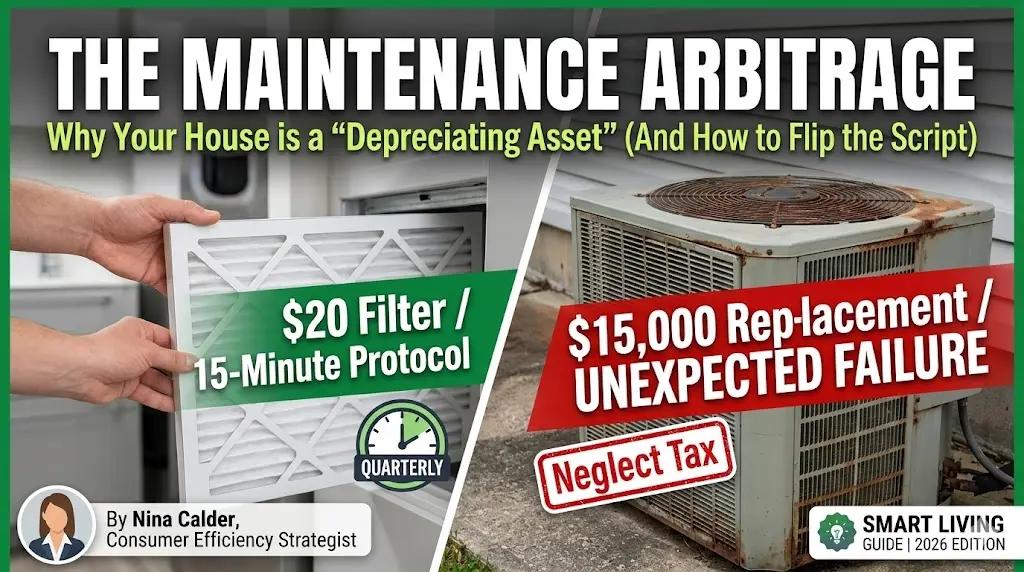
Let’s look at the Payback Lens of a single $20 MERV-8 air filter. In 2026, electricity prices have made 'static pressure' a major budget killer. When your filter is clogged with dust and pet dander, your HVAC motor has to work 30% harder to pull air through. This doesn't just increase your monthly bill by $40; it drastically shortens the lifespan of the blower motor.
- The Scenario: A neglected system fails in year 7. A maintained system lasts until year 15.
- The Cost of Failure: A new high-efficiency heat pump installation in 2026 averages $14,000 - $18,000.
- The Maintenance Cost: $20 per quarter + 5 minutes of labor = $1,200 over 15 years.
- The Arbitrage: By spending $1,200 incrementally, you save $14,000 and roughly $3,000 in energy inefficiency. That is a total gain of $15,800 for about 5 hours of total work over a decade. Your hourly rate for changing filters is effectively $3,160/hour.
Part 3: The 'Invisible' Killers (Sediment and Pressure)
In my Smart Living framework, we focus on the two things you can’t see but that destroy your wealth: Sediment and Pressure.
The Water Heater 'Sandcastle'
If you live in an area with hard water, minerals settle at the bottom of your tank. This creates a layer of insulation between the burner and the water. You are essentially trying to boil water through a brick. This 'Sandcastle' eventually cracks the inner lining of the tank. The Nina Rule: A 10-minute flush once a year costs $0 but adds 5-7 years to the unit's life.
The Pressure Regulator Valve (PRV) Mystery
Most homes have a PRV that keeps street pressure (often 100+ PSI) down to a safe 50-60 PSI. When these fail—and they do—your appliances are subjected to 'High Blood Pressure.' Your dishwasher seals start to weep, your toilets run constantly, and your $2,000 smart-fridge ice maker explodes. A $15 pressure gauge from the hardware store can save you from a $5,000 multi-appliance catastrophe.
Part 4: The 'Shield Protocol' – Your 15-Minute Quarterly Roadmap
I don't believe in weekend-long 'home projects.' I believe in micro-habits. Here is the Set-and-Forget schedule I use to maintain my own efficiency baseline:
- Quarterly (10 Mins): Change the HVAC filter and pour a cup of vinegar down the condensate drain line. This prevents the #1 cause of AC service calls: the 'clogged drain pan' overflow that shuts down the system.
- Bi-Annually (5 Mins): Vacuum the coils behind or beneath your refrigerator. Dust acts as an insulator; clean coils mean the compressor runs 20% less. Cost-Per-Use of your vacuum just went up.
- Annually (15 Mins): Test your sump pump and check the PRV pressure. Walk the perimeter of your house and look for 'splash zones' where gutters are overflowing. Water is the only thing that can destroy a house faster than fire.
- Every 2 Years (30 Mins): Replace the sacrificial anode rod in your water heater. This $40 rod is designed to rust so your tank doesn't. It is the single most 'insider' trick in the plumbing industry.
Part 5: Scam-Proofing Your Home Services
In 2026, the 'Service Membership' model is everywhere. Companies want to charge you $30/month for a 'Priority Care' plan. Nina’s Take: Most of these are overpriced insurance for people who refuse to spend 15 minutes on a Saturday. Unless you have a highly complex, proprietary AI-managed geothermal system, you don't need a subscription. You need a calendar invite and a screwdriver.
When you do need a professional, always ask for the 'Diagnostic Only' rate first. Avoid companies that offer 'Free Estimates'—they usually bake the cost of that 'free' visit into a 400% markup on parts. Buy your own parts (like capacitors or igniters) and pay for the labor. You’ll save 60% instantly.
The Verdict: Living Lighter
Smart Living isn't just about the latest gadgets; it's about reducing the 'noise' in your life. Financial noise comes from unexpected $2,000 bills. Mental noise comes from wondering if that weird smell in the basement is a disaster in progress. When you implement the Maintenance Arbitrage, you aren't just saving money; you are buying Certainty.
Your home should be your sanctuary, not a source of constant financial leakage. Stop being a 'break-fix' consumer. Become a systems manager. The 15 minutes you spend today is the $15,000 you get to keep tomorrow.