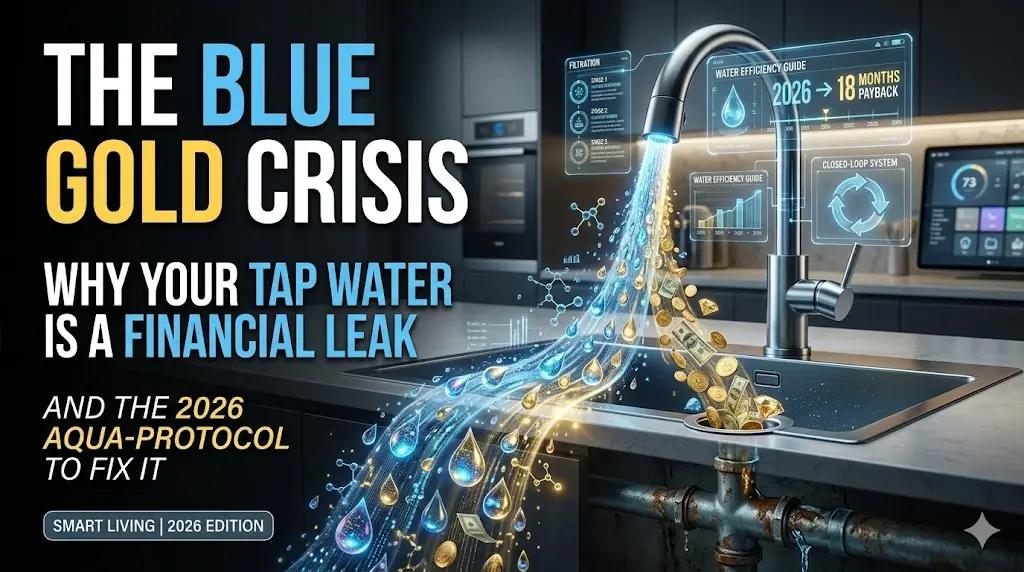
The Great Utility Heist: Why Your Home is Bleeding Cash and the 2026 'Energy Revolution' Protocol to Reclaim It
Every month, it’s the same ritual. You open your digital utility portal, wince at the total, and wonder where it all went. You’ve done what the brochures told you: you switched to LED bulbs, you bought an 'Energy Star' dishwasher, and you keep the thermostat at a modest 68 degrees. Yet, your bill in 2026 is 30% higher than it was two years ago. Why? Because the modern energy industry isn't designed to sell you power—it’s designed to profit from your inefficiency and your lack of storage.
As a Consumer Efficiency Strategist, I’ve spent the last decade dissecting home systems. I don't care about 'green' for the sake of being green; I care about systems that work, math that adds up, and habits that don't require me to live like a monk in a cave. We are currently witnessing an 'Energy Revolution,' but it’s not the one being sold to you by flashy solar startups. The real revolution is happening at the intersection of micro-storage, thermal integrity, and what I call 'Grid-Smart' behavioral economics.
Energy independence isn't a product you buy from a door-to-door salesman; it’s a system you build by plugging the leaks and gaming the peak hours. If you haven't audited your home's 'Ghost Load' this year, you are essentially leaving a hundred-dollar bill on the sidewalk every single month.
The Invisible Drain: Exposing the 'Ghost Load' Phenomenon
In 2026, our homes are more connected than ever. Your 'smart' fridge, your always-on AI assistants, your mesh Wi-Fi routers, and even your standby-mode EV charger are all part of what I call the Ghost Load. This is power consumed by devices that are doing absolutely nothing for you. Statistics now show that the average professional household loses between 20% and 25% of its total electricity budget to these 'vampire' devices.
Why is this happening? Because manufacturers prioritize 'Instant-On' convenience over your wallet. Your TV isn't 'off'; it's waiting for a signal. Your coffee machine isn't 'off'; it's keeping a heating element warm for a cup you might not brew for another six hours. To fight this, I utilize a Friction Audit. We don't just pull plugs—we use automated smart relays at the circuit level. If nobody is in the home office, that circuit is dead. No standby, no ghost load, no waste. This single change often yields a higher ROI than a $10,000 solar array because the cost of implementation is nearly zero.
The 'Evening Tax': Why When You Use Energy Matters More Than How Much
The biggest scam in 2026 utility pricing is 'Time-of-Use' (TOU) rates. The utility companies know exactly when you get home, when you start the laundry, and when you turn on the oven. They call this 'Peak Demand,' and they charge you a massive premium for it. In some regions, power between 5:00 PM and 9:00 PM is 400% more expensive than power at midnight.
This is where the 'Energy Revolution' actually begins. It’s called Peak Shaving. You don't need to stop using power during these hours; you just need to stop buying it from the grid during these hours. By utilizing mid-sized LFP (Lithium Iron Phosphate) batteries, you can 'arbitrage' your energy. You charge your battery at 2:00 AM when power is essentially free, and you run your high-drain entertainment systems and lighting off that battery during the evening peak.
- The Math: If your peak rate is $0.45/kWh and your off-peak rate is $0.12/kWh, shifting just 10kWh of daily usage saves you $3.30 a day. Over a year, that's over $1,200.
- The Hardware: A 5kWh portable power station now costs roughly $1,500. Your payback period is roughly 15 months. After that, you are profiting from the utility company's own pricing greed.
- The Habit: It’s set-and-forget. Modern smart batteries handle the scheduling automatically. You don't even notice the switch.
The Solar Myth: Why 90% of Homeowners are Doing it Wrong
I’m going to say something unpopular: Most rooftop solar installations in 2026 are bad investments. Why? Because people buy them for the wrong reasons. They buy them to 'save the planet' or because they saw a Facebook ad promising 'Zero Electric Bills.' But they fail to account for the Payback Lens.
If you finance a $30,000 system over 20 years, you aren't independent; you’ve just traded a utility bill for a bank loan. Furthermore, if you don't have storage, you're selling your excess solar power back to the grid for pennies and buying it back at night for dollars. The 'Energy Revolution' framework dictates a Storage-First approach. I would rather see a client spend $5,000 on high-quality batteries and $2,000 on a small, DIY-friendly solar kit than $30,000 on a full-roof lease. Small, modular systems allow you to scale as your budget allows, and they reach ROI three times faster.
Thermal Integrity: The Boring Secret to 40% Savings
We often focus on the 'sexy' tech—batteries, panels, apps—but the most effective tool in the Energy Revolution is Air Sealing. Your home is a pressure vessel. In the summer, you're paying to cool air that is constantly leaking out through your attic and light fixtures. In the winter, your expensive heat is escaping through the 'Stack Effect.'
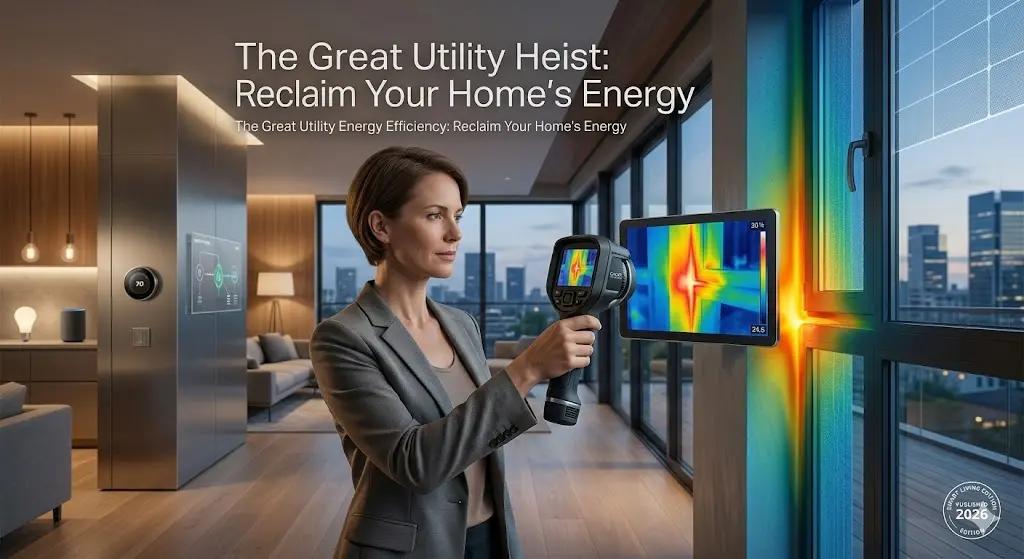
Using a simple thermal camera (you can rent one for $40), you will likely find that your house has dozens of 'thermal bridges.' These are literal holes in your wallet. Spending one weekend with a few cans of spray foam and some weather stripping has a Payback Period of roughly three weeks. It is the single most efficient use of your time and money in the entire Smart Living ecosystem.
The 30-Day 'Grid-Smart' Protocol
If you’re ready to stop being a passive victim of utility inflation, follow this tiered roadmap for the next 30 days:
- Day 1-7 (The Audit): Rent a thermal camera. Find the leaks. Walk through your house at night and look for every glowing LED or 'warm' brick-style power adapter. If it's warm and you aren't using it, it's stealing from you.
- Day 8-14 (The Seal): Apply weather stripping to all doors leading outside. Use outlet gaskets on every exterior-wall outlet. Insulate the attic hatch. Total cost: <$150. Potential savings: 15% of HVAC costs.
- Day 15-25 (The Battery Shift): Invest in a high-capacity LFP battery. Map your peak-hour devices (TV, laptops, lamps) to this battery. Set the battery to recharge during off-peak hours only.
- Day 26-30 (The Micro-Gen): If you have sun exposure, add a single 200W-400W rigid panel to keep your battery topped off during the day. This provides 'Survival Power' during grid outages and reduces your net-metering reliance.
Insider FAQ: What They Don't Want You to Ask
Q: Are those 'Energy Saving Boxes' you see on TikTok real?
A: Absolutely not. They are power factor correction capacitors that do nothing for a residential bill. They are the biggest scam in the energy space. Avoid them at all costs.
Q: How do I know if my appliances are 'Efficiency Fakes'?
A: Look at the standby power rating. An appliance can be efficient while running, but if it draws 15 watts while 'off' just to stay connected to your Wi-Fi, it’s a net loss for a smart home.
Q: Is the 'Energy Revolution' about to get cheaper?
A: Yes and no. Battery prices (LFP) are dropping, but utility rates are climbing faster. The best time to start was two years ago; the second best time is today. The 'Payback Period' is getting shorter every month because of how expensive the grid has become.
The Verdict: From Consumer to Manager
The era of cheap, reliable, 'dumb' energy is over. In 2026, you either manage your energy or you let the utility companies manage your bank account. The Energy Revolution isn't a miracle cure—it's a series of calculated, high-ROI upgrades that shift the power (literally) back into your hands.
Stop waiting for a government subsidy or a 'breakthrough' in fusion. The technology to cut your bill in half already exists, it's affordable, and it’s sitting in your local hardware store. Plug the leaks, store the cheap power, and stop being the easiest target on the grid.